About the Park
Souss Massa National Park
A 33,800-hectare sanctuary on Morocco's Atlantic coast, where wetlands, steppe, and coastline converge to shelter some of Africa's most endangered species.
Our Mission
Protecting Morocco's Atlantic Biodiversity
Souss Massa National Park was established in 1991 by royal decree to protect a fragile mosaic of ecosystems along Morocco's southwestern Atlantic coast. Stretching between the cities of Agadir and Tiznit, the park safeguards tidal estuaries, coastal cliffs, semi-arid steppe, sand dunes, and sections of the iconic argan forest - an ecosystem found nowhere else on Earth.
The park's primary mandate is the conservation of the Northern Bald Ibis (Geronticus eremita), a critically endangered bird whose last significant wild breeding colony nests on the sea cliffs within park boundaries. Today, Souss Massa also serves as a centre for species reintroduction, habitat restoration, and community-based ecotourism.
Diverse Landscapes
Four Ecosystems, One Park
The park acts as an ecological bridge where the Atlantic Ocean meets the semi-arid fringes of the Anti-Atlas and Sahara, creating an extraordinary range of habitats within a compact area.
Estuarine Wetlands
The mouths of the Oued Souss and Oued Massa rivers create tidal estuaries that serve as critical stopovers for migratory waterbirds. Greater flamingos, spoonbills, marbled ducks, and ospreys congregate here during the October-to-April migration window.
Coastal Cliffs & Dunes
Rocky sea cliffs along the Atlantic provide nesting habitat for the Northern Bald Ibis, while extensive sand dune systems stabilised by native vegetation protect the interior steppe from coastal erosion and saltwater intrusion.
Semi-Arid Steppe
Inland from the coast, grazed steppe and scrubland transition into rocky, arid terrain. This habitat supports Dorcas gazelle, red fox, jackal, and the reintroduced Scimitar-horned Oryx and Addax antelope within fenced reserves.
Argan Forest
The park protects sections of the arganeraie, an endemic ecosystem recognised by UNESCO. The argan tree (Argania spinosa) provides food, oil, and timber for local Amazigh (Berber) communities and supports a unique food web including Barbary ground squirrels.
Flagship Species
The Northern Bald Ibis
Once widespread across North Africa, the Middle East, and southern Europe, the Northern Bald Ibis is now one of the world's rarest birds. Souss Massa is its last major stronghold.
A Bird on the Brink - and Coming Back
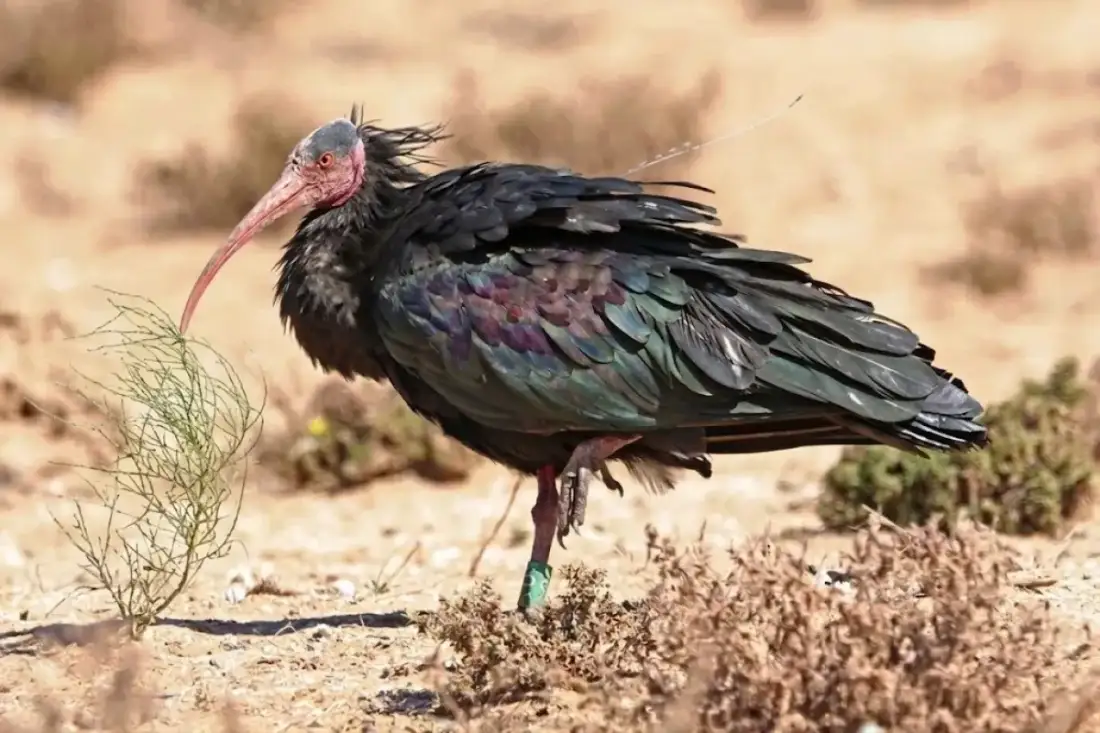
The Northern Bald Ibis (Geronticus eremita) was once found from the Alps to the Atlas. Hunting, habitat loss, and pesticide use reduced the global wild population to fewer than 100 breeding pairs by the 1990s, nearly all of them in the Souss-Massa region.
The park's dedicated protection programme (including nest-site monitoring, predator management, and community engagement with local fishermen and farmers) has helped the Moroccan population stabilise and grow. As of recent surveys, around 700 wild birds are recorded in Morocco, the vast majority linked to colonies within or near the park.
Northern Bald Ibis (Geronticus eremita)
Biodiversity
Other Key Species
Dorcas Gazelle
One of the smallest true gazelles, adapted to arid steppe and scrubland. Listed as Vulnerable by IUCN.
Scimitar-Horned Oryx
Extinct in the wild across its former Saharan range, reintroduced into fenced reserves within the park since the mid-2000s.
Greater Flamingo
Large flocks overwinter at the Oued Massa estuary, making the park one of Morocco's premier flamingo-watching sites.
Marbled Duck
A globally declining species that uses the park's freshwater marshes and quiet estuarine channels as breeding and wintering habitat.
Barbary Ground Squirrel
Endemic to northwest Africa, commonly seen in the argan forest zone where it feeds on nuts, seeds, and fruit.
Argan Tree
The iconic Argania spinosa, endemic to Morocco. Source of argan oil, essential to local Amazigh livelihoods and a UNESCO-recognised biosphere resource.
Conservation History
Key Milestones
Park Established
Souss Massa National Park is officially designated by royal decree to protect the last wild Northern Bald Ibis nesting colonies and the surrounding Atlantic coastal ecosystems.
Ibis Monitoring Programme
A systematic nest-monitoring and predator-control programme is launched in collaboration with international conservation bodies, stabilising the breeding population.
Ramsar Wetland Designation
The Oued Massa estuary is designated a Ramsar Wetland of International Importance, recognising its critical role as a migratory bird stopover on the East Atlantic Flyway.
Species Reintroduction
Scimitar-horned Oryx and Addax, both extinct in the wild across their former Saharan range, are reintroduced into fenced reserves within the park as part of a regional recovery programme.
Community Partnership & Growth
Local Amazigh guides, fishermen, and farmers now work alongside park rangers in habitat monitoring, anti-poaching patrols, and ecotourism operations, making conservation a shared livelihood.
Plan Your Visit
Experience the Park
Whether you're a dedicated birder, a wildlife photographer, or simply seeking an off-the-beaten-path Moroccan experience, Souss Massa rewards every visitor with its raw, unspoiled beauty.