Along a stretch of Atlantic cliffs south of Agadir lives one of the rarest birds on earth. It is not a flamingo or an eagle, nothing that obvious. It is a strange, dark, almost prehistoric-looking bird with a bald red face and a shaggy neck, and for most of the last century, everyone assumed it was disappearing for good.
The Northern Bald Ibis nearly went extinct. Then Morocco quietly became the place that saved it.
What exactly is a Northern Bald Ibis?
The Northern Bald Ibis, known to scientists as Geronticus eremita and to locals as the Waldrapp or hermit ibis, is a large black wading bird that breaks almost every rule its relatives follow. Most ibises wade through marshes. This one nests on bare cliff ledges in dry, semi-desert terrain and walks across open ground hunting insects, larvae, and small reptiles.
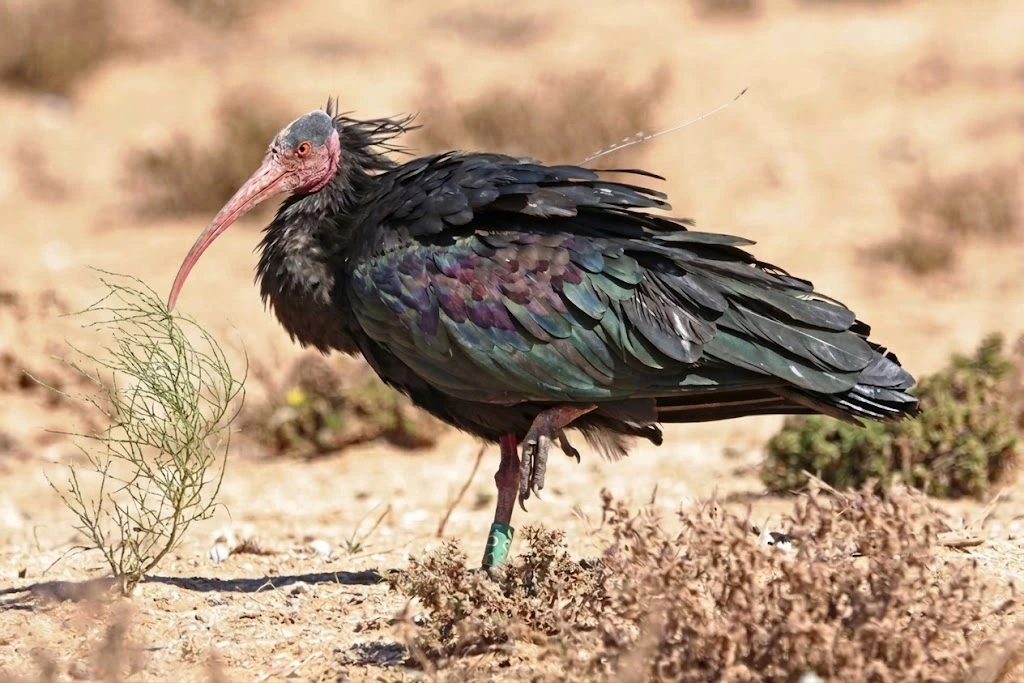
Up close, it is unmistakable. Glossy black feathers catch a bronze and violet shine in the sun, a loose ruff of spiky plumes sits at the back of the neck, and the face and crown are completely bare, covered in wrinkled red skin that runs straight into a long, curved red bill. It looks like nothing else in the sky.
Is the Northern Bald Ibis extinct?
No, but it came close enough that most ornithologists expected it to disappear within their lifetime. The species was reclassified from Critically Endangered to Endangered in 2018 on the IUCN Red List, after decades of steady population growth in Morocco, where numbers climbed from around 200 birds in the 1990s to roughly 600 to 700 today.
Everywhere else, the story is much darker. The eastern population, which once bred across Turkey and Syria and migrated thousands of kilometers to winter in Ethiopia, is now considered functionally extinct in the wild. A small relict colony discovered in Palmyra, Syria in 2002 collapsed over the following two decades under the weight of conflict and habitat loss. A semi-captive colony still survives in Birecik, Turkey, and small reintroduced groups exist in Spain and Austria, but none of them are truly wild. Morocco’s Atlantic coast, and specifically Souss Massa National Park, is the last place on the planet where a self-sustaining wild population still breeds on its own terms.
Why were Northern Bald Ibis hunted to extinction?
The short answer is that the bird was simply too easy to catch. It breeds in dense colonies on accessible cliff ledges, and its fledglings could be taken by hand before they ever learned to fly. In Europe, that was enough to wipe the species out entirely by the early 1600s, hunted for food until there were none left.
The Middle Eastern population followed centuries later, worn down by hunting, pesticide poisoning, and collisions with power lines along its long migratory route through Eritrea, Sudan, Saudi Arabia, and Jordan. Because the species breeds slowly and in small, tightly clustered colonies, it never had the numbers to absorb that kind of pressure. In Morocco, the threats look different today, mainly agricultural pesticides and disturbance near nesting cliffs, but the underlying vulnerability is the same one that nearly finished the species off three centuries ago.
What makes the bald ibis so unusual?
- It belongs to a genus of exactly two living species, the other being the Southern Bald Ibis of South Africa, and it is the only one found north of the equator
- It nests on open cliff ledges instead of trees or reed beds, almost unheard of among ibises and spoonbills
- Males and females look nearly identical, though males run slightly larger with longer bills
- Morocco’s population no longer migrates at all, while the extinct eastern population once flew one of the longest migratory routes of any ibis on record
- It appears in Ancient Egyptian art and European folklore going back thousands of years, making it one of the most historically documented birds in the world
You can read the full taxonomic record and historical range on Wikipedia’s Northern Bald Ibis page, which draws on decades of published field research.
How to identify one in the field
Look for an all-black, mid-sized bird with a bare, wrinkled red face, a long curved red bill, and red legs. In flight, the wingbeats are slow and slightly stiff, and the neck stretches forward rather than tucking in the way a heron’s does. On the ground, that loose spiky ruff at the back of the neck gives it a windswept, almost punk-rock silhouette, and it forages by walking steadily forward, probing the soil rather than wading through water.
Where to find them in Morocco
The wild colony nests on sea cliffs inside Souss Massa National Park and along the nearby Tamri coastline, about 60 kilometers south of Agadir. From there, the birds forage inland across the park’s dry steppe, especially around the Oued Massa estuary, where early morning light and food availability both peak. Because this population never migrates, there is no bad season to look for it, though sightings near the estuary cliffs tend to be the most reliable year round.
Do they still migrate anywhere?
Not in Morocco. The wild population here is entirely sedentary, staying along the same stretch of coast all year. That is actually a fairly recent shift. Historically, the species’ eastern population made a dramatic seasonal journey between breeding cliffs in Turkey and Syria and wintering grounds in Ethiopia. That tradition vanished along with the population itself, but in an unexpected twist, a European reintroduction project has since trained a newly reestablished colony to migrate between Austria and Italy behind human-piloted microlight aircraft, the first time the species has migrated over Europe since the 1600s.
Northern Bald Ibis vs Southern Bald Ibis
The two species share a genus and a family resemblance, but they live on opposite ends of the continent and are easy to tell apart once you know what to look for.
- Range: the Northern Bald Ibis survives almost entirely in Morocco, with a tiny remnant in Turkey, while the Southern Bald Ibis is endemic to the high grasslands of South Africa, Lesotho, and Eswatini
- Head shape: the Southern Bald Ibis has a neat, rounded red cap on the crown, while the Northern Bald Ibis has a shaggier, more extensive bare red face plus that loose feathered ruff at the neck
- Numbers: the Northern Bald Ibis is Endangered with roughly 700 wild birds left, while the Southern Bald Ibis is Near Threatened with a much larger population of 8,000 to 10,000
- Habitat: one favors dry coastal steppe near sea level, the other lives in cool, high-altitude mountain grassland
Where to see them for yourself
Souss Massa National Park is not just a habitat for the Northern Bald Ibis. It is the species’ last real stronghold anywhere on earth. Guided birdwatching tours along the Oued Massa estuary give you the best odds of watching the colony on its home cliffs, alongside flamingo, osprey, and the hundreds of other bird species that share this same protected stretch of coastline.
If you are planning a trip from Agadir, this guided national park tour covers the estuary and the ibis nesting cliffs in a single half day or full day excursion, with a local guide who knows exactly where the colony is roosting that week.