
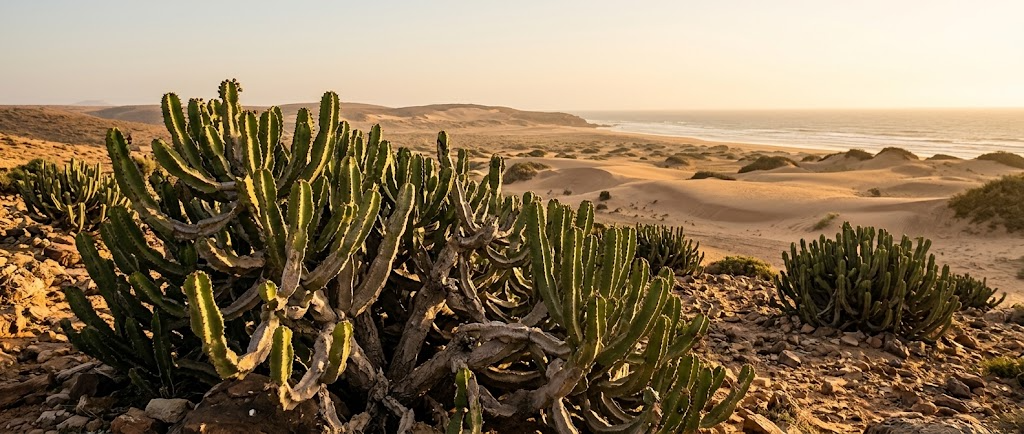
Drive along the coastal steppe south of Agadir and the landscape eventually fills with something that looks, at first glance, unmistakably like a desert straight out of Arizona, dense clumps of spiny green columns rising from the dry ground in every direction. It is not a cactus. It never was.
Euphorbia Officinarum is the plant behind that scene, a Moroccan endemic succulent that defines the landscape around Souss Massa National Park almost as much as the argan tree does.
What is Euphorbia Officinarum?
Euphorbia Officinarum is a spiny, cactus-like succulent shrub endemic to a narrow strip of southwestern Morocco and a small surrounding area of Western Sahara, Mauritania, and Algeria. The form found around Souss Massa National Park, subspecies echinus, grows in dense, mounded, sea urchin-like clumps of upright, angular, spine-covered stems, an appearance that gave the subspecies its name, since echinus means hedgehog or sea urchin in Latin. It thrives in exactly the kind of harsh, dry, coastal steppe found throughout the region south of the Oued Souss, forming a distinctive vegetation type local botanists call “steppe à euphorbe oursin,” sea urchin spurge steppe, which covers much of the coastal strip encompassing the park itself.
Is Euphorbia a cactus or a succulent?
It is a succulent, not a cactus, despite looking remarkably similar. True cacti belong to the family Cactaceae and are native almost exclusively to the Americas, while Euphorbia belongs to an entirely different family, Euphorbiaceae, native to Africa, Madagascar, and parts of Asia. The spiny, columnar, water-storing appearance shared by many Euphorbia species and true cacti is a textbook example of convergent evolution, two unrelated plant lineages independently developing similar shapes and survival strategies because they were solving the exact same problem, storing water and deterring herbivores in an arid climate, on opposite sides of the world. A reliable way to tell them apart at a glance is the sap, Euphorbia species release a thick, milky white latex when cut or damaged, something true cacti never do.
What is Euphorbia Officinarum used for?
The species has a long history in traditional Moroccan medicine, where it is locally known as Tikiout or Daghmus. Its milky latex, extracted and diluted, has traditionally been applied to treat skin conditions, certain eye ailments, and intestinal parasites, and it has also been used as a folk remedy for diabetes and specific kidney and urinary conditions, sometimes combined with other native plants such as prickly pear and jujube. Modern phytochemical research has confirmed the latex contains a genuinely diverse range of bioactive compounds, including triterpenes and diterpenes with documented antibacterial, antioxidant, and anti-inflammatory properties, which is part of why the species continues to attract scientific interest well beyond its traditional folk use. Bees that forage on its flowers also produce a distinctive, highly prized monofloral honey in parts of southern Morocco. None of this makes the plant safe for casual use, its latex is genuinely toxic, and traditional applications rely on carefully controlled, low concentration preparations handled by people with specific knowledge of the plant, not a do-it-yourself remedy.
How do you treat Euphorbia sap in eyes?
Treat any Euphorbia sap in the eyes as a medical emergency and act immediately. Flush the affected eye continuously with clean, lukewarm water or sterile saline for at least 15 to 20 minutes, holding the eyelid open to ensure the rinse reaches the entire eye surface, and remove contact lenses first if the person is wearing them. Do not rub the eye, since this can spread the irritant latex and worsen corneal damage. After flushing, seek emergency medical or ophthalmological care right away, since Euphorbia latex is a documented cause of significant eye irritation and, in more serious cases, corneal injury. If possible, note which plant was involved or bring a photo to help medical staff assess the exposure accurately. This is general safety information, not a substitute for professional medical care, and anyone with a genuine eye exposure should seek emergency treatment immediately rather than relying on home care alone.
Are Euphorbia Officinarum plants easy to keep alive?
For an experienced succulent grower, reasonably so, since the species is naturally adapted to poor soil, intense heat, and long dry periods. The most common mistakes come from overcaring rather than undercaring, particularly overwatering, which this plant tolerates far worse than neglect. Given sharp drainage, strong light, and a genuinely dry rest period through the cooler months, cultivated specimens can be relatively low maintenance, though the species is slow growing and, given its protected status in the wild, any plant grown in cultivation should come from a nursery propagating it responsibly rather than wild collected stock.
Best soil for Euphorbia Officinarum plants
Sharp drainage is the single most important factor. A mix built around mineral, gritty material, roughly equal parts standard cactus or succulent potting mix combined with coarse sand, pumice, or perlite, prevents the kind of prolonged moisture retention that leads to root rot in this species. A slightly alkaline to neutral pH suits it well, reflecting the rocky, mineral-rich coastal soils it grows in naturally, and a shallow, wide container generally works better than a deep one, since the plant’s root system is adapted to spread rather than dive deep in search of water.
How to propagate Euphorbia Officinarum cuttings
Propagation from stem cuttings is the standard method. Take a healthy stem section with clean, sharp tools, always wearing gloves and eye protection given the toxicity of the latex that will immediately seep from the cut. Set the cutting aside in a dry, shaded spot for several days to a week, allowing the cut end to callus over fully, since planting a fresh, unhealed cut into soil is one of the most common causes of rot at this stage. Once calloused, insert the cutting into a dry, sharply draining mix and withhold water for another week or two before beginning light watering, giving the new roots time to establish before they are asked to take up moisture.
Why is my Euphorbia turning yellow?
Yellowing is most commonly a sign of overwatering or poor drainage, since this species is built for drought and struggles when its roots stay wet for extended periods, often leading to root rot that shows up first as yellow, softening tissue. Insufficient light can cause a similar but slower yellowing and stretching as the plant reaches for more sun. Less commonly, yellowing can reflect a natural seasonal response during dormancy or simply an older stem segment naturally aging out, but if the yellowing appears suddenly alongside soft or mushy tissue, checking the roots and easing back on watering is the right first step.
Euphorbia Officinarum vs Euphorbia Resinifera identification
These two Moroccan endemic spurges are frequently confused, since both form spiny, toxic-latex succulent clumps used in similar traditional remedies, but they occupy different regions and have subtly different forms. Euphorbia officinarum subsp. echinus is found specifically in the southwestern coastal steppe around the Souss Valley and the Anti-Atlas, forming looser, more sprawling mounded clumps, while Euphorbia resinifera is native to the Middle Atlas, particularly around Beni Mellal and Azilal, and typically forms tighter, more compact cushion-like domes. Historically, E. resinifera is the species behind Euphorbium, one of the oldest documented plant-derived drugs in recorded medical history, while E. officinarum carries its own distinct, though overlapping, tradition of use in southwestern Morocco specifically. Both plants share the family’s characteristic toxic white latex and a very similar general appearance, and the most reliable way to distinguish them in the field is location rather than shape alone.
Where to buy rare Euphorbia succulents
Reputable specialist succulent nurseries and established plant societies are the right source, not informal roadside or market sellers, since responsibly grown, nursery-propagated Euphorbia officinarum is available through the international succulent trade without placing any additional pressure on wild Moroccan populations. Because the species is a narrow-range Moroccan endemic, wild collection for the horticultural trade is a genuine conservation concern, and buyers who care about the species’ long term survival should specifically look for cultivated, nursery-grown material with clear provenance rather than assuming a cheap, unlabeled specimen was ethically sourced.
Where to see them for yourself
The coastal steppe inside and around Souss Massa National Park is one of the best places anywhere to see Euphorbia Officinarum growing at scale in its true native habitat, forming dense stands alongside the region’s other drought adapted native plants. The dense, spiny clumps are unmistakable once you know what you are looking at, and a genuinely defining feature of the landscape here.
If you are planning a trip from Agadir, this guided national park tour covers the coastal steppe where Euphorbia Officinarum grows, as part of a single half day or full day excursion with a local guide.