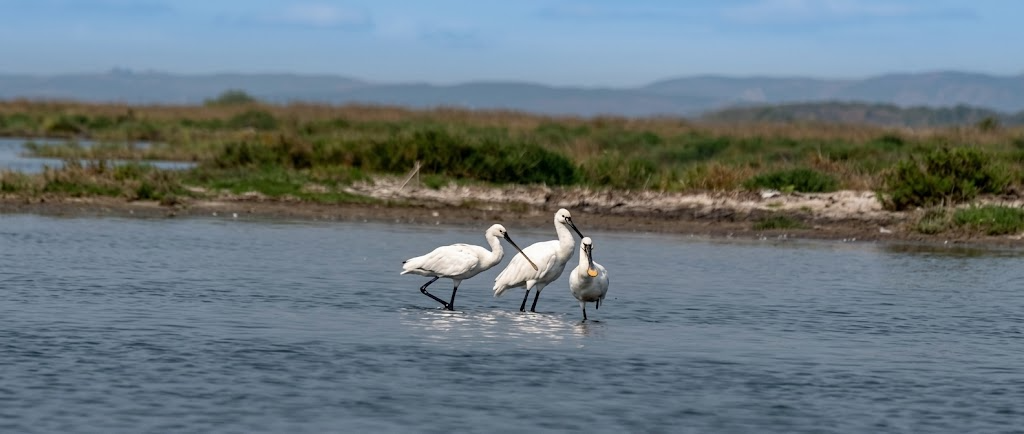
Walk along almost any estuary on Morocco’s Atlantic coast in winter and, sooner or later, you will spot a bird sweeping its head side to side through the shallows like it is mowing the water. That strange feeding motion belongs to one of the most distinctive wading birds in the world, instantly recognizable and often mistaken for something it is not.
The Eurasian Spoonbill is a common winter visitor to Morocco’s coastal wetlands, and the estuaries around Souss Massa National Park are among the most reliable places on the entire coast to see one feeding up close.
What is the Eurasian Spoonbill?
The Eurasian Spoonbill (Platalea leucorodia) is a large, entirely white wading bird best known for its long, flat, spoon-shaped bill, which it holds open just below the water’s surface and sweeps from side to side to feel for prey. Adults stand around 80 to 95 centimeters tall, with black legs and a mostly black bill tipped in yellow. During the breeding season, adults grow a shaggy crest at the back of the head and a pale yellow patch on the upper breast, both of which disappear outside the breeding period. Outside Africa, the species breeds widely across Europe and western Asia, with the largest colonies found in the Netherlands, Spain, and along parts of the Mediterranean, before migrating south to winter across North and West Africa.
Are spoonbills related to flamingos?
No, despite the superficial resemblance, spoonbills and flamingos are not closely related at all. Both are large, mostly white or pink wading birds with long legs and unusual bills, and both often feed in the same shallow lagoons, which is exactly why the confusion is so common. But spoonbills belong to the ibis and spoonbill family, Threskiornithidae, the same family as the Northern Bald Ibis, while flamingos sit in their own entirely separate order, Phoenicopteriformes. The similarities are a case of convergent evolution, both groups adapted long legs and specialized bills to feed in the same type of shallow, saline wetland habitat, not shared ancestry.
What do Eurasian Spoonbills eat?
Eurasian Spoonbills feed almost entirely by touch rather than sight, using sensitive nerve endings inside the bill to detect prey in murky or turbid water. Their diet consists mainly of small fish, aquatic insects, crustaceans, worms, and amphibian larvae, caught by walking slowly through shallow water while sweeping the partly open bill side to side in a steady arc. This feeding technique lets them hunt effectively even where visibility is poor, and it is most active during the morning and evening, or timed to tidal rhythms in coastal estuaries like the ones found around Souss Massa National Park.
Eurasian Spoonbill identification tips
A few field marks make the Eurasian Spoonbill easy to confirm at a distance:
- All-white plumage, with a pale yellow tinge sometimes visible on the breast during the breeding season
- A long, flat, spatula-shaped bill, black with a yellow tip, unlike any other European or North African wading bird
- Black legs, noticeably longer and thinner than a heron’s in proportion to body size
- A distinctive feeding motion, walking slowly forward while sweeping the bill side to side through shallow water
- In flight, the neck is held fully extended forward, not tucked in like a heron, and the wingbeats are slow and steady
How to identify a juvenile Eurasian Spoonbill
Juveniles look similar to adults at a glance but show a few clear differences. Young birds have black tips on their outer flight feathers, visible mainly in flight, and a pale pink or dull horn-colored bill that has not yet developed the strong black and yellow adult pattern, gradually darkening over the following one to two years. Juveniles also lack the shaggy crest and yellow breast patch that breeding adults display, giving them a plainer, smoother-headed look overall.
Difference between Eurasian and African Spoonbill
The two species overlap in parts of North and West Africa during the winter, which makes confusion common, but a close look at the head resolves it immediately. The African Spoonbill (Platalea alba) has a bare red face and red legs, with no crest at any time of year, while the Eurasian Spoonbill has black legs, a mostly black bill with a yellow tip, and grows a crest during the breeding season. The African Spoonbill is also a year-round resident across much of sub-Saharan Africa, while the Eurasian Spoonbill is largely a seasonal winter visitor to North Africa, arriving from European and West Asian breeding grounds.
Spoonbill nesting sites in North Africa
Breeding colonies of the Eurasian Spoonbill remain rare in North Africa, which makes each confirmed site genuinely significant for the species. Morocco holds the only known breeding population of the nominate subspecies on the African continent, historically centered on a mixed heronry at Smir, near Tetouan, active since 1994. A second breeding colony of around 20 pairs was discovered in 2017 at the Oued El-Maleh dam near Casablanca, nesting alongside herons and egrets in a similar mixed colony setting, as reported by ornithological researchers documenting the discovery. Further south, a group of roughly 20 spoonbills has also been recorded feeding in the Oued Souss estuary near Agadir alongside several hundred Greater Flamingos, though this group is not currently a confirmed breeding colony.
Do Eurasian Spoonbills winter in Morocco?
Yes, and reliably so. Morocco’s Atlantic estuaries and lagoons are an important wintering ground for the species, with birds arriving from European breeding colonies each autumn and remaining through the cooler months before heading back north in spring. The Oued Massa estuary, inside Souss Massa National Park, is one of the more consistent wintering sites on this stretch of coast, where spoonbills forage alongside Greater Flamingo, Audouin’s Gull, and the park’s resident Northern Bald Ibis colony.
Where to see them for yourself
The wetlands around Souss Massa National Park offer one of the more consistent chances on Morocco’s coast to watch Eurasian Spoonbills feeding at close range, often in the same stretch of water as flamingo, osprey, and the park’s other wintering waterbirds. Early morning and the hours around low tide tend to bring the most reliable activity.
If you are planning a trip from Agadir, this guided national park tour covers the estuary where spoonbills feed, as part of a single half day or full day excursion with a local birding guide.