Ask most people what killed off Egypt’s asps and cobras in local folklore, and they’ll usually guess wrong. It was not a bird of prey or a farmer with a stick. It was a low, fast, grey-brown carnivore barely the size of a house cat, moving with a speed and precision that earned it a reputation stretching back thousands of years.
The Egyptian Mongoose still lives across much of Morocco today, including the reedbeds and scrubland of Souss Massa National Park, though most visitors never get more than a fleeting glimpse of one.
What is the Egyptian Mongoose?
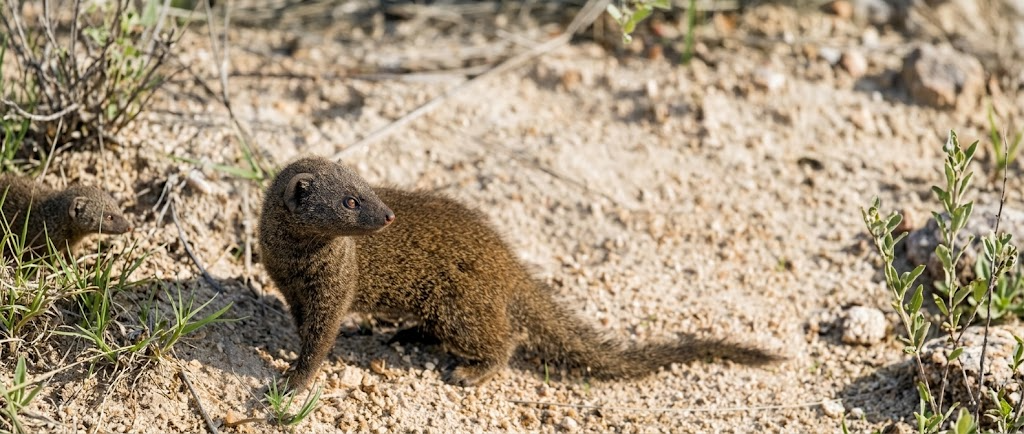
The Egyptian Mongoose (Herpestes ichneumon), also known as the ichneumon or large grey mongoose, is the largest species of mongoose and a member of the family Herpestidae, more closely related to civets and hyenas than to cats or weasels despite a similar body shape. It has an elongated body, a pointed snout, small rounded ears nearly hidden in its fur, and a long, bushy tail ending in a distinct black tuft. Its coarse, grizzled coat ranges from grey to reddish brown, flecked with lighter and darker bands along each individual hair, giving it a mottled, almost salt and pepper appearance at a distance.
How big is an Egyptian Mongoose?
An adult Egyptian Mongoose typically measures 48 to 60 centimeters from nose to tail base, with an additional 33 to 54 centimeter tail that is often nearly as long as the body itself. Adults weigh between 1.7 and 4 kilograms, making this the largest mongoose species found anywhere, noticeably bigger than the small Indian mongoose species many people picture when they hear the word. That long tail and slender build are built for speed and agility through dense vegetation, not raw size or strength.
Is mongoose bite venomous?
No. The Egyptian Mongoose’s own bite carries no venom at all, it is simply a sharp-toothed carnivore bite like that of any small predator. The confusion usually comes from the species’ famous reputation for hunting venomous snakes, which has led to a persistent myth that mongooses are immune to snake venom. That is not quite accurate either. Research shows mongooses have a genetic adaptation that makes certain snake neurotoxins less effective against them, giving real partial resistance, combined with lightning fast reflexes and defensive tactics like puffing up their fur to look larger, but they are not fully immune and a serious envenomation can still injure or kill one.
Where do Egyptian Mongoose live?
The species has one of the widest ranges of any mongoose, found across most of sub-Saharan Africa, throughout North Africa including Morocco, Algeria, Tunisia, Libya, and Egypt, and in a separate population across the Iberian Peninsula in Spain and Portugal, along with parts of the Middle East including Israel, Jordan, Lebanon, Syria, and Turkey. It favors habitat near water and cover, riverbanks, marshes, dense scrub, and coastal vegetation, though it also readily uses cultivated fields and vegetated canal edges. In Morocco, it is found throughout the country, including the wetlands, coastal scrub, and semi-desert terrain inside Souss Massa National Park.
What does an Egyptian Mongoose eat in the wild?
Egyptian Mongooses are opportunistic carnivores with a genuinely broad diet. They eat invertebrates, small mammals, birds and their eggs, amphibians, fish, and reptiles, including venomous snakes when the opportunity arises, and will take fruit occasionally as well. Eggs are a particular favorite, and mongooses have a distinctive technique for cracking them, throwing the egg backward between their hind legs against a rock or hard surface until it breaks. Their scientific name reflects an old, unconfirmed belief that the species specialized in raiding crocodile nests, a story more myth than documented fact, but one that stuck regardless.
Are mongooses friendly to people?
Not in the way that word usually implies. Wild Egyptian Mongooses are naturally shy, solitary, and crepuscular, most active at dawn and dusk, and they generally avoid human contact rather than seek it out. They are not domesticated animals, and even mongooses raised from a young age in captivity remain fundamentally wild in temperament, alert, independent, and prone to biting or scratching if they feel cornered or threatened. Any calm behavior around familiar handlers in captivity is closer to tolerance than genuine friendliness.
Are Egyptian Mongooses dangerous to humans?
Generally, no. Wild Egyptian Mongooses pose very little direct threat to people, since their instinct is to flee rather than confront anything human-sized. Bites and scratches can occur if one is cornered, handled, or approached too closely, particularly around a den or young, and like most wild carnivores they can carry diseases such as rabies in certain regions, which is a good reason to never attempt to touch or feed one. Left alone at a safe distance, which is exactly how most visitors encounter them in a place like Souss Massa National Park, they present essentially no risk at all.
Can you keep an Egyptian Mongoose as a pet?
In most places, no, and for good reason. The Egyptian Mongoose is a protected wild species across much of its range, and keeping one without the correct permits is illegal in Morocco and across the European Union, where several mongoose species are additionally restricted under invasive species regulations due to the damage introduced mongoose populations have caused to native wildlife on islands elsewhere in the world. Beyond the legal restrictions, mongooses do not adapt well to a domestic setting, they are highly active, territorial, difficult to house safely, and retain strong wild instincts throughout their lives, which is why reputable wildlife organizations consistently advise against keeping any mongoose species as a pet.
Egyptian Mongoose vs common mongoose differences
“Common mongoose” is a name often used loosely for the Indian Grey Mongoose (Herpestes edwardsii), a different and smaller species native to South Asia rather than Africa. The two are easy to separate:
- Size: the Egyptian Mongoose is noticeably larger, the biggest species in the mongoose family, while the Indian Grey Mongoose is a mid-sized species well below it in both length and weight
- Range: the Egyptian Mongoose is native to Africa, the Iberian Peninsula, and the Middle East, while the Indian Grey Mongoose is native to the Indian subcontinent and parts of Central Asia
- Coat: the Egyptian Mongoose has a coarser, more grizzled grey-brown coat with a distinctive black-tipped tail, while the Indian Grey Mongoose has a finer, more uniformly grey coat with a lighter tail tip
- Habitat preference: the Egyptian Mongoose favors dense vegetation near water, while the Indian Grey Mongoose is more adaptable to open and urban habitat, which is part of why it became a common introduced pest species on islands worldwide
How to spot Egyptian Mongoose in Morocco
Patience and timing matter more than luck. Egyptian Mongooses are crepuscular, so early morning and early evening give the best odds, scanning along the edges of reedbeds, riverbanks, and dense scrub rather than open ground. Inside Souss Massa National Park, the vegetated margins around the Oued Massa estuary are a good place to watch quietly from a distance, since the mongoose relies on cover and moves quickly between patches of vegetation rather than crossing open terrain. Look for a low, fast-moving, grey-brown shape with a long tail trailing behind it, often gone again within a few seconds of first appearing.
Where to see them for yourself
Egyptian Mongoose sightings inside Souss Massa National Park are opportunistic rather than guaranteed, but the estuary reedbeds and scrub margins offer some of the better odds in the region, often in the same habitat used by marbled duck and other wetland species the park protects. A guide familiar with the terrain significantly improves your chances of a real sighting rather than a missed shadow in the brush.
If you are planning a trip from Agadir, this guided national park tour covers the estuary and scrub habitat where the mongoose is most active, as part of a single half day or full day excursion with a local guide.