Fewer than 100 truly wild individuals of this species are thought to survive anywhere on earth, scattered across two remote pockets of the Sahara that most people will never visit. That number alone makes the Addax one of the rarest large mammals left on the planet, rarer than most people realize, and rarer than almost any other antelope alive today.
Morocco has spent nearly two decades trying to change that story, and the Addax population now living inside Souss Massa National Park is a direct part of that effort.
What is the Addax?
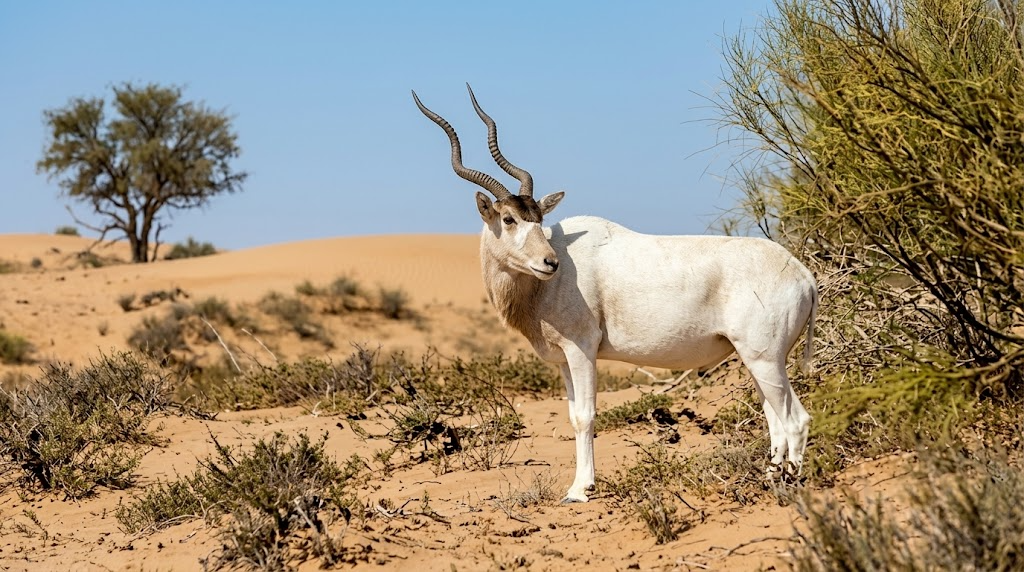
The Addax (Addax nasomaculatus), also known as the white antelope or screwhorn antelope, is a desert-adapted antelope native to the Sahara, instantly recognizable by its long, twisted, spiraling horns, which reach 70 to 85 centimeters in males and slightly shorter in females. Its coat shifts with the seasons, nearly white in summer to reflect intense solar heat, and a duller grayish brown in winter that helps retain warmth in cooler weather. It lives in small herds of five to 20 animals led by the oldest female, moving slowly and nomadically across flat, open terrain in search of the sparse vegetation that follows scattered desert rainfall.
Is the Addax still found in the Moroccan wild?
Yes, though the full picture requires a bit of nuance. Since 2008, Souss Massa National Park has maintained a protected, fenced population of Addax inside its Safia reserve, part of the same rehabilitation program that supports the park’s Scimitar Oryx. This population is free-ranging within a large protected area rather than confined to small enclosures, and it has grown steadily since the program began. Separately, in 2019, Morocco carried out the first ever unfenced reintroduction of Addax into the wild anywhere in Africa, releasing animals into the M’Hamid Nature Reserve in the southeast of the country. Together, these two Moroccan efforts represent one of the most significant Addax recovery programs in the species’ entire historical range.
Are there Addax in Morocco today?
Yes, and Morocco is now one of only a small number of countries anywhere that hosts the species at all, alongside Niger, Chad, and reintroduced populations in Tunisia. Between the Souss Massa reserve, the M’Hamid reintroduction site, and additional semi-captive breeding populations elsewhere in the country, Morocco represents a meaningful and growing share of the world’s remaining Addax, a species that had disappeared from the country’s wild landscape for decades before these programs began.
What is the primary threat to the Addax?
Uncontrolled hunting, supercharged by modern weapons and desert-going vehicles, is what pushed the Addax from a species numbering in the hundreds of thousands to fewer than 100 wild individuals within a single century. Motorized hunting parties could reach and eliminate entire herds in remote desert terrain that once offered the species near total protection through sheer inaccessibility. Today, the threat has broadened. Oil and gas exploration across the Addax’s remaining Saharan range brings new roads, vehicle traffic, and human activity into previously untouched habitat, while ongoing civil unrest and conflict across parts of Niger and Chad, the species’ last truly wild strongholds, make consistent conservation enforcement extremely difficult to sustain.
Conservation status of Addax in Morocco
Globally, the Addax is listed as Critically Endangered on the IUCN Red List, with wild populations restricted to Niger’s Termit and Tin Toumma reserve and scattered pockets across Chad. Morocco’s population falls outside that “wild” count in the strictest technical sense, since the Souss Massa herd lives within a large fenced reserve and the M’Hamid group is a recent, closely monitored reintroduction, but both are treated by conservation organizations as genuinely important contributions to the species’ overall recovery, providing secure breeding groups insulated from the hunting and conflict pressures still affecting the species elsewhere. The long-term goal shared by Moroccan authorities and international partners is to grow these populations enough to eventually support further releases into fully open, unfenced desert habitat.
Are Addax considered sacred in Morocco?
There is no strong documented evidence that the Addax holds specific sacred status within Moroccan culture. The species does have a much older symbolic history further east, appearing in Ancient Egyptian art and hunting scenes, sometimes associated with the god Set, but that association belongs to Egyptian rather than Moroccan tradition. In modern Morocco, the Addax’s significance is better described as a national conservation symbol rather than a religious or sacred one, representing the country’s broader effort to restore species that had vanished from its Saharan landscape.
Addax antelope habitat in North Africa
The Addax is built for the harshest, most open terrain the Sahara has to offer, flat sandy plains, gravel flats, and shifting dune fields where vegetation is scarce and scattered unpredictably by rainfall. Wide, flat hooves let it cross loose sand without sinking, and it survives without ever needing to drink free water, extracting all the moisture it needs from the grasses and succulents it grazes on, aided by highly efficient kidneys that minimize water loss. It historically ranged from Morocco and Mauritania in the west across to Sudan and Egypt in the east, though today it survives in the wild only in small, isolated pockets of that once vast range, with Morocco’s reintroduced populations representing one of the few expanding exceptions to an otherwise declining picture.
How to identify an Addax antelope
A few features make the Addax easy to tell apart from Morocco’s other reintroduced antelope species. Look for long, dramatically spiraled horns twisting in an open corkscrew shape, quite different from the straighter, curved horns of the Scimitar Oryx. The coat color shifts seasonally, pale and nearly white in the hot summer months, darker grayish brown in winter, with a tuft of dark hair on the forehead and a white patch across the face that gives the species its scientific name, nasomaculatus, meaning “spotted nose.” Its build is stockier and less streamlined than a gazelle’s, reflecting a slow, energy-conserving gait suited to covering long distances across sand rather than sprinting from predators.
Where to see them for yourself
Inside Souss Massa National Park, the Addax roams the Safia reserve alongside Scimitar Oryx and Dorcas Gazelle, part of the same long-running effort to bring Saharan species back to a landscape they had disappeared from decades ago. It remains one of the most reliable places in the world to see this critically endangered antelope, rarer in the wild than almost any other large mammal on the continent.
If you are planning a trip from Agadir, this guided national park tour covers the reserve where the Addax roams, along with the park’s other reintroduced species, in a single half day or full day excursion with a local guide.