Most snake encounters in Morocco last about two seconds. A dry rustle in the scrub, a fast olive-grey shape crossing the trail, and it is already gone before you have fully registered what you saw. If it was long, quick, and built like a whip, there is a good chance you just met the country’s largest and most commonly encountered snake.
The Montpellier Snake is one of the most widespread reptiles in Morocco, including inside Souss Massa National Park, and despite its size and dramatic defensive display, it is far less dangerous than it looks.
What is the Montpellier Snake?
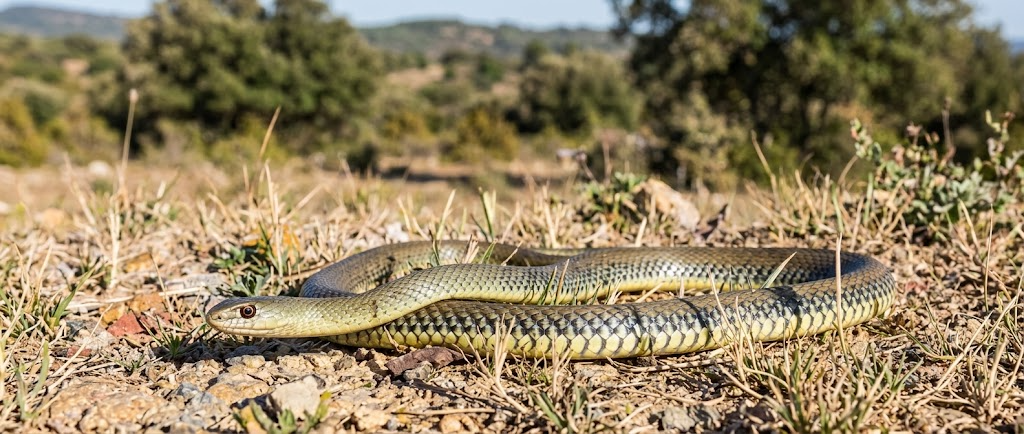
The Montpellier Snake (Malpolon monspessulanus) is a large, fast-moving colubrid snake named after the French city of Montpellier, where it was first scientifically described. It has a narrow head that is poorly distinguished from the body, a pronounced ridge above each eye that gives it a permanently stern, almost angry expression, and large round-pupiled eyes that sometimes show an orange or reddish tint. Adult coloration is typically a fairly uniform grey, olive, greenish, or brownish tone along the back, often with a paler, yellowish belly marked with darker blotches. It is a diurnal, highly active hunter, most often seen moving quickly across open, sun-warmed ground during the day.
Is the Montpellier Snake venomous?
Yes, technically, but the practical risk to people is very low. The Montpellier Snake is opisthoglyphous, meaning its venom-delivering fangs sit far back in the upper jaw rather than at the front, unlike a viper. To inject venom effectively, the snake needs a sustained, deep bite, essentially chewing rather than a quick strike, which almost never happens in an accidental human encounter. The venom itself is also relatively mild and slow acting, and confirmed cases of human envenomation are rare, with most on record involving someone directly handling or provoking the snake.
Is the Montpellier Snake dangerous to humans?
No, not under normal circumstances. Despite its size and its startling defensive display, rearing up, flattening its neck, and hissing loudly in an almost cobra-like posture, the Montpellier Snake overwhelmingly prefers to flee rather than fight. Genuine bites to humans are uncommon and almost always the result of someone picking the snake up or attempting to handle it. Left alone, a Montpellier Snake will typically retreat into cover within seconds, and its reputation among Moroccan herpetologists is that of a shy, defensive bluffer rather than a genuine threat.
Are Montpellier Snakes aggressive?
Not in the way the word usually implies. When cornered or startled, the Montpellier Snake puts on one of the most convincing defensive displays of any European or North African snake, rearing the front third of its body upward, spreading and flattening its neck, and hissing persistently, a performance clearly designed to look as threatening as possible. But this is a bluff, not an attack. Given any open path to escape, the snake will almost always take it rather than strike, and true aggression, actively pursuing or attacking a person, is not typical behavior for this species.
How large do Montpellier Snakes grow?
The Montpellier Snake is the largest snake species found in Europe and one of the largest in North Africa, with most adults measuring between 1.5 and 2 meters. Exceptionally large individuals have been recorded up to 2.55 meters, weighing as much as 2 kilograms, though snakes of that size are unusual. Females in Morocco’s coastal southern populations have been recorded around 1.85 meters, giving a realistic sense of the upper range most people are likely to actually encounter in the field.
What does a baby Montpellier Snake look like?
Juveniles look noticeably different from the fairly uniform adults. Young Montpellier Snakes show a much more contrasted pattern, with fine dark spots scattered along the flanks and larger, irregular dark markings running along the back, set against a lighter background color. As the snake matures, this juvenile pattern gradually fades into the more uniform grey, olive, or brownish tone typical of adults, which is part of why young and adult individuals are sometimes mistaken for entirely different species by anyone unfamiliar with the change.
Where do Montpellier Snakes live in Morocco?
The species is found across most of Morocco, with two recognized subspecies dividing the country. The nominate form, Malpolon monspessulanus monspessulanus, occupies most of the north and center, while the subspecies saharatlanticus is found across the Anti-Atlas range and the coastal strip stretching from Tiznit in the north down to Dakhla in the south, according to field research documented by Moroccan herpetologists. The Souss Valley and the coastal zone between Agadir and Tiznit sit right in the overlap between these two forms, making this stretch of coast, including the land around Souss Massa National Park, a genuinely active part of the species’ Moroccan range.
Can I find Montpellier Snakes in the Sahara?
Not in the classic sense of deep, shifting sand dunes, but yes, in the drier, Sahara-influenced country along the coast. The southern subspecies favors dry, rocky soils and semi-desert steppe rather than true dune fields, and its range extends well into the arid coastal belt bordering the northern Sahara, down toward Dakhla in Western Sahara. It is more accurate to say the Montpellier Snake thrives at the desert’s edge, in dry, sun-baked, rocky terrain, than to picture it crossing open sand dunes the way a desert-specialist reptile might.
Can I find Montpellier Snakes in Souss Massa National Park?
Yes. The park sits within the documented overlap zone between the two Moroccan subspecies, and the dry steppe, rocky ground, and scrub habitat inside Souss Massa National Park match exactly the terrain this species prefers. Sightings are most likely during the day in warmer months, when the snake is most active hunting lizards and other small prey across open, sun-exposed ground.
How to avoid snakes while hiking in Morocco
A few simple habits significantly reduce the odds of a surprise encounter with any snake species, Montpellier Snake included:
- Wear sturdy, closed footwear and long trousers on any trail through scrub, rocky ground, or dry steppe
- Watch where you place your hands and feet, especially around rocks, crevices, and low vegetation where a snake might be resting
- Stay on marked paths where possible, since snakes are far less commonly encountered on heavily used trails
- If you see a snake, stop, give it space, and let it move away on its own rather than approaching for a closer look or a photo
- Hike with a guide in areas you do not know well, since local guides know exactly which terrain and seasons carry the highest activity
Where to see them for yourself
The dry steppe and scrubland inside Souss Massa National Park offer good odds of a genuine Montpellier Snake sighting for anyone hiking or touring with a knowledgeable guide, part of the same rich reptile habitat that also supports the park’s lizards, geckos, and other native reptile species. As with most wildlife encounters in the park, patience and a guide who knows the terrain make the difference between a fleeting glimpse and a real sighting.
If you are planning a trip from Agadir, this guided national park tour covers the steppe and scrub habitat where the Montpellier Snake is most often seen, as part of a single half day or full day excursion with a local guide.