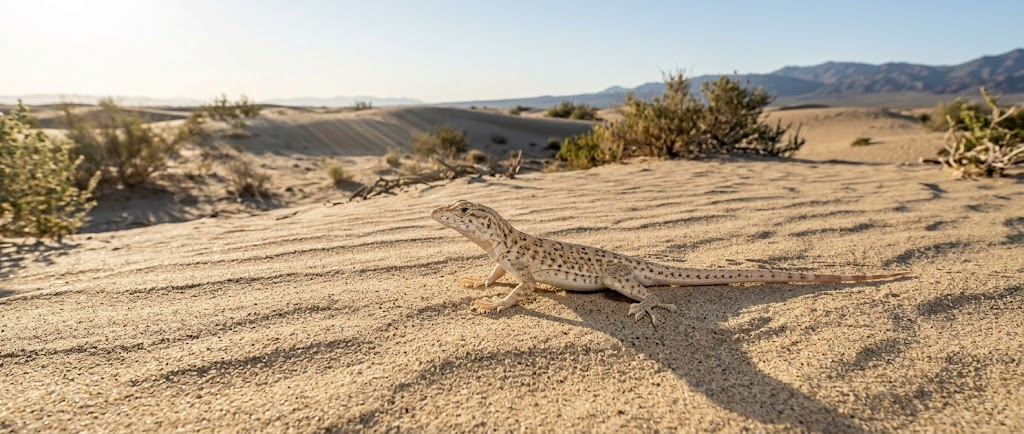
Walk across the coastal dunes south of Agadir on a sunny afternoon and you will likely see one before you consciously register what it is, a small, fast shape darting across the sand in short bursts, then freezing completely still. Blink and it has vanished into a burrow. This is one of the most common reptiles along Morocco’s Atlantic coast, and almost nobody outside a small circle of herpetologists has ever heard its name.
The Aurora Fringe-toed Lizard is a genuine coastal specialist, and a recent scientific survey found it to be one of the most frequently encountered reptile species inside Souss Massa National Park.
What is the Aurora Fringe-toed Lizard?
The Aurora Fringe-toed Lizard (Acanthodactylus aureus) is a small, sand-adapted lizard in the family Lacertidae, part of the wider Acanthodactylus genus, whose name literally translates from Greek as “spiny finger,” referring to the distinctive fringe of spiny scales running along the edges of its toes. That fringe is not decorative, it is a functional adaptation that spreads the lizard’s weight across loose sand, letting it sprint and dig without sinking the way a smooth-toed lizard would. This particular species is a genuine coastal specialist, restricted to a narrow strip of dune habitat along the Atlantic coast, and a recent species distribution study covering 16 reptile species inside Souss Massa National Park identified it as one of the park’s most frequently recorded lizards, found at more than half of all surveyed sites.
How to identify Moroccan fringe-toed lizards
Like most members of the Acanthodactylus group, the Aurora Fringe-toed Lizard is small, typically around 15 to 20 centimeters including the tail, with a slender, streamlined body built for speed rather than bulk. Look for a sandy tan to pale golden coloration that blends closely with the dune sand it lives on, a narrow head, long toes edged with the telltale spiny fringe, and quick, jerky movement patterns, short bursts of speed followed by an abrupt stop and a few characteristic head bobs. Distinguishing this species from closely related Acanthodactylus lizards in the same coastal region usually requires a close look at scale counts and precise habitat, since several similar species overlap in range along Morocco’s southern coast, which is part of why the group remains genuinely under-documented compared to Morocco’s larger, more visible reptiles.
How do fringe-toed lizards dig in sand?
The same spiny scale fringe that gives the species its name doubles as a digging and traction tool. When threatened, an Aurora Fringe-toed Lizard can disappear into loose sand remarkably fast, using rapid, shimmying body movements combined with the fringed toes to push sand aside and bury itself just beneath the surface, sometimes in only a few seconds. This “sand-swimming” behavior serves two purposes at once, escaping predators and avoiding the most extreme surface heat during the hottest parts of the day, since sand just a few centimeters down is noticeably cooler than the scorching surface layer.
Diet of Moroccan sand-dwelling lizards
The Aurora Fringe-toed Lizard is insectivorous, feeding mainly on ants, beetles, grasshoppers, spiders, and other small arthropods it finds while actively foraging across open sand and low dune vegetation. Like other Acanthodactylus species, it hunts by sight and scent, flicking its tongue to pick up chemical cues while moving in short, alert bursts across the ground, and it will occasionally supplement its diet with small amounts of plant material, particularly seeds or flowers, during the driest and leanest parts of the year when insect prey becomes scarce.
What is the lifespan of an Acanthodactylus lizard?
Detailed lifespan studies specific to the Aurora Fringe-toed Lizard are limited, but small lacertid lizards in this genus are generally understood to live several years in the wild under stable conditions, broadly comparable to other small desert and coastal lizard species. Survival is closely tied to predation pressure and habitat stability rather than age alone, since these are small prey animals for a wide range of birds, snakes, and mammals, and most individuals in the wild face far greater risk from predation than from old age.
Are Aurora Fringe-toed Lizards dangerous?
No. This is a small, entirely harmless, insect-eating lizard with no venom and no meaningful bite risk to a person. Like most small lacertid lizards, its only real defense is speed, freezing, and rapidly burying itself in sand to disappear from a threat, not confrontation. The only genuine risk it poses is to the insects it hunts.
Can you keep an Aurora Fringe-toed Lizard as a pet?
It is not recommended, and in most cases not legally straightforward either. Moroccan wildlife regulations restrict the collection and export of native reptile species, and a highly specialized, narrow-range coastal species like this one is a particularly poor candidate for captivity, since it depends on very specific sand composition, temperature, and humidity conditions that are extremely difficult to replicate outside its natural dune habitat. Conservation-minded herpetologists generally discourage keeping any wild-caught native lizard as a pet, both for legal reasons and because these coastal specialists rarely thrive long term outside the environment they evolved for.
Are fringe-toed lizards endangered in Morocco?
The Aurora Fringe-toed Lizard is not currently classified as globally threatened, but its restricted range is a genuine long-term concern. The species survives in a narrow band of Atlantic coastal dune habitat, and that specific habitat type is under increasing pressure across Morocco’s coast from tourism development, coastal urbanization, and habitat disturbance. A species tied this closely to one narrow strip of terrain is inherently more vulnerable to local habitat loss than a widespread generalist, which is exactly why protected coastal reserves like Souss Massa National Park matter so much for its long-term security.
Acanthodactylus aureus distribution
The correct scientific name for this species is Acanthodactylus aureus, sometimes searched with slightly different spellings. Its confirmed range is a narrow, largely coastal strip running along the Atlantic seaboard from around Agadir, Morocco in the north, south through Western Sahara, and down to Mboro in Senegal, according to detailed range mapping by Moroccan herpetology researchers. Populations have also been recorded extending more than 100 kilometers inland in parts of the Sahara, notably along the Saguia El-Hamra wadi, though the species remains fundamentally a coastal sand dune specialist across the great majority of its range, with the area immediately south of Agadir sitting right at the northern edge of where it is found.
Best places to see lizards in Morocco
Morocco’s reptile diversity is genuinely underrated, and a handful of sites stand out for reliable sightings. Souss Massa National Park is one of the strongest, having been the subject of a dedicated scientific survey identifying 16 distinct reptile species across its dunes, steppe, and rocky terrain, including the Aurora Fringe-toed Lizard as one of the most consistently recorded. The Anti-Atlas foothills and the semi-desert country around Guelmim offer good odds for a wider mix of Acanthodactylus species, while the coastal dune systems stretching south toward Sidi Ifni share much of the same sandy habitat this species depends on. In all of these areas, early morning and mid-afternoon sun, when lizards bask and forage most actively, offer the best viewing windows.
Where to see them for yourself
The coastal dunes inside Souss Massa National Park are genuinely one of the best documented places anywhere to see the Aurora Fringe-toed Lizard, part of a rich and underappreciated reptile community that also includes the park’s Montpellier Snake and other native reptiles. Moving slowly and scanning open, sun-warmed sand gives the best chance of spotting one before it vanishes.
If you are planning a trip from Agadir, this guided national park tour covers the dune and steppe habitat where the species is most often seen, as part of a single half day or full day excursion with a local guide.