Somewhere between Agadir and Essaouira, a photo exists that stops almost every tourist mid-drive, a herd of goats standing calmly in the upper branches of a tree, eating as if it were the most normal thing in the world. It is not photoshopped, and it is not a trick. It is one small, strange detail in the life of a tree found almost nowhere else on earth.
The Argan Tree grows across the exact region surrounding Souss Massa National Park, and it is one of the most ecologically and economically important plants in all of Morocco.
What is the Argan Tree?
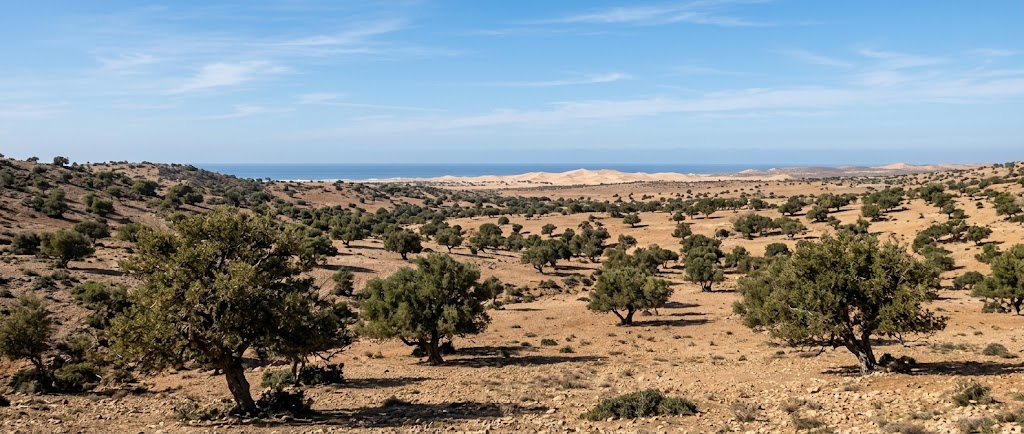
The Argan Tree (Argania spinosa, also classified in some botanical references as Sideroxylon spinosum) is a slow-growing, thorny, drought-tolerant tree native to the semi-arid southwest of Morocco. It typically reaches 8 to 10 meters in height, with a short, gnarled, twisting trunk and a dense, spreading canopy that provides rare shade across an otherwise harsh, open landscape. Remarkably long lived, individual trees can survive 150 to 200 years, with some sources citing even older specimens. It produces a small, round, olive-like fruit that ripens slowly, taking over a year to mature fully, and contains a single extremely hard nut prized for the oil-rich kernel inside.
Why is the Argan Tree only found in Morocco?
The Argan Tree is endemic almost entirely to a single region, the Souss Valley and the surrounding arid zone of southwestern Morocco, stretching roughly between Agadir and Essaouira, with only a small additional population across the border in Algeria’s Tindouf region. This extremely narrow natural range comes down to a highly specific set of conditions the species has adapted to over an exceptionally long evolutionary history, tolerating temperatures up to 50 degrees Celsius, surviving on minimal and unpredictable rainfall through a deep root system capable of reaching water far below the surface, and thriving in poor, rocky soils that defeat most other tree species entirely. According to the United Nations’ recognition of the species, the tree functions as a genuine bulwark against desertification in this specific landscape, a role closely tied to the exact soil, climate, and ecological relationships found only in this one part of the world, which is why transplanting the species elsewhere has proven so difficult despite repeated attempts.
How long does an Argan Tree take to produce fruit?
Argan Trees are slow to mature by almost any standard. Young trees generally begin producing a meaningful fruit crop somewhere between 8 and 15 years of age, and reaching full, stable productivity can take considerably longer still, part of why the species has never been suited to fast agricultural turnover the way many fruit crops are. Once mature, an established tree typically yields around 8 kilograms of fruit per year, though yield varies significantly with rainfall and tree age, and each individual fruit itself takes over a year to fully ripen on the branch, an unusually long fruiting cycle compared to most cultivated trees.
The goat climbing Argan Trees phenomenon
The sight of goats standing in argan branches is real, and it has a genuinely practical origin. Local goats are drawn to the sweet pulp surrounding the argan fruit, and their hooves, unusually adapted with two spreading toes and firm dewclaws, give them enough grip and balance to climb the short, gnarled branches safely. Traditionally, this behavior served a real economic purpose, the goats would eat the fruit and pass the hard, undigested nut through their digestive system, and farmers would later collect and clean these nuts, saving the extremely labor-intensive step of manually stripping the pulp by hand. Modern argan oil production has largely moved away from this method, partly due to hygiene standards and a detectable “goaty” scent some buyers noticed in the finished oil, and today the sight of climbing goats, especially along tourist routes near Essaouira, is as much a photographed spectacle as it is a working part of the oil trade.
Why is argan oil so expensive?
The cost comes down almost entirely to labor and scarcity. Producing just one liter of argan oil can require around 30 kilograms of fruit and roughly 15 hours of hand labor, cracking each rock-hard nut individually, most commonly by women’s cooperatives using traditional stone tools, since no efficient mechanical process has fully replaced this step without damaging the delicate kernel inside. Add to that the tree’s extremely narrow natural range, its slow growth and modest yield per tree, and strong international demand across the cosmetics and culinary industries, and the combination of scarce supply, intensive manual labor, and global demand is what keeps genuine argan oil priced well above most other vegetable and culinary oils.
Is argan fruit edible for humans?
The fleshy outer pulp of the argan fruit is not toxic, but it is not something people typically eat, since it is bitter and unpalatable compared to the fruits most people are used to, and it is used almost entirely as fodder for goats, camels, and other livestock rather than as human food. The part of the plant that actually reaches people is the oil pressed from the kernel inside the hard nut, used both in cooking, where it has a distinct, nutty, roasted flavor, and in cosmetics, where it is valued for its moisturizing properties. In short, people consume argan oil regularly, but almost never the raw fruit itself.
Argan Tree vs Olive Tree: what is the difference?
The two are often compared since both produce a prized culinary oil from a small, oval fruit, but they are entirely different species from different plant families. The Argan Tree belongs to the Sapotaceae family and grows only in a narrow strip of southwestern Morocco, while the olive tree belongs to the Oleaceae family and has been cultivated across the entire Mediterranean basin for thousands of years. Structurally, argan trees are shorter, thornier, and far slower growing, and their fruit is processed differently, the flesh is stripped away and the hard nut inside is cracked to extract oil from the kernel, rather than the whole olive fruit being pressed as it is for olive oil. Argan Trees are also dramatically more drought tolerant and slower to reach productive maturity than olive trees, reflecting the far harsher, drier environment they evolved to survive in.
Are Argan Trees protected by law?
Yes. Morocco’s argan forests, known collectively as the Arganeraie, are managed as a protected national forest domain, and the entire ecosystem has been recognized internationally through several formal designations, including UNESCO Biosphere Reserve status since 1998, inclusion of traditional argan know-how on UNESCO’s Intangible Cultural Heritage list in 2014, and FAO recognition as a Globally Important Agricultural Heritage System in 2018. These protections exist because argan forest cover has declined significantly over the past century due to overharvesting, grazing pressure, and land conversion, and regulated harvesting, replanting programs, and export controls now form part of an active effort to stabilize and rebuild the species’ range rather than lose more of it.
Can I grow an Argan Tree in my backyard?
Technically it has been attempted in a handful of other arid regions, including parts of Israel, Texas, Spain, and Australia, but success has been limited and inconsistent. The Argan Tree is extraordinarily slow growing even under ideal conditions, thorny, and highly specific about soil drainage, temperature extremes, and rainfall patterns, making it a genuinely difficult species to establish outside its native range, let alone in a typical home garden. On top of the practical challenges, the species’ protected status in Morocco means seeds and live plant material are subject to export restrictions, which further limits how easily anyone outside the region can legally source authentic planting stock. For nearly everyone, seeing the species thriving in its one true home in southwestern Morocco remains a far more realistic goal than growing one at home.
Where to see them for yourself
Souss Massa National Park sits directly within the Arganeraie Biosphere Reserve, making it one of the best places anywhere to see mature Argan Trees growing in their true native habitat, alongside the wider ecosystem of plants and wildlife that depends on the argan woodland for shelter and food. A short drive beyond the park’s boundaries, particularly toward Essaouira, also offers a real chance to see the famous tree-climbing goats in action.
If you are planning a trip from Agadir, this guided national park tour covers the park’s argan woodland habitat as part of a single half day or full day excursion with a local guide.