Few trees have as split a reputation as this one. In one part of the world, it is a feared invader blamed for draining rivers dry and choking out native plant life. In another, it is a quiet, essential part of the landscape, lining riverbanks and estuaries, holding soil in place, and giving shelter to birds that would otherwise have nowhere to rest.
The Tamarisk growing along the Oued Massa estuary inside Souss Massa National Park belongs firmly to the second story, a native tree doing exactly the ecological job it evolved to do.
What is a Tamarisk tree?
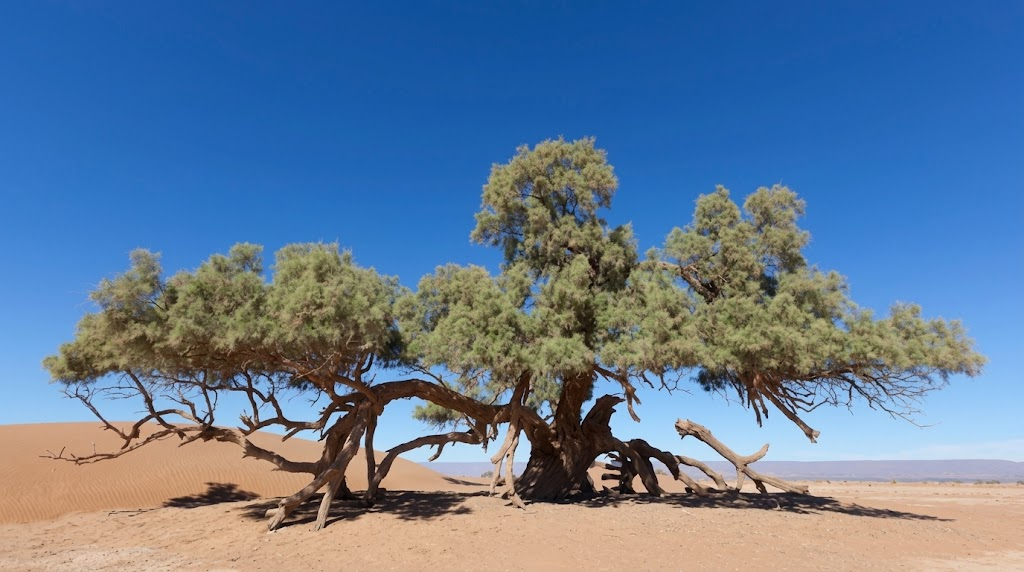
Tamarisk is the common name for trees and shrubs in the genus Tamarix, a group of around 50 to 60 species native to the Mediterranean Basin, North Africa, the Middle East, and Central Asia. It is a hardy, deciduous or evergreen shrub or small tree, typically reaching 3 to 8 meters tall, with slender, arching branches covered in tiny, scale-like leaves that give the whole plant a feathery, almost conifer-like texture. In spring and summer it produces dense, plume-like clusters of small pink or white flowers, and the bark on older growth develops a distinctive reddish-brown, deeply furrowed texture. Its defining biological trait is an extraordinary tolerance for salty, poor soils, an adaptation that shapes almost everything else about how and where it grows.
Is salt cedar the same as tamarisk?
Broadly, yes. “Salt cedar” is simply the common name most widely used in North America for several naturalized Tamarix species, particularly Tamarix ramosissima and closely related hybrids, while “tamarisk” is the more general common name used for the genus as a whole, including in its native Mediterranean and North African range. In everyday use, the two terms are essentially interchangeable, though “salt cedar” tends to appear specifically in discussions of the species’ invasive behavior in the American Southwest, while “tamarisk” is the term more commonly used across its native range in Morocco, the Mediterranean, and the Middle East.
Are Tamarisk trees invasive?
The honest answer depends entirely on where you are standing. In North America, Tamarisk, introduced from Eurasia and North Africa in the 1800s for erosion control and ornamental planting, has become a genuinely serious invasive species, particularly along rivers in the American Southwest, where it outcompetes native cottonwoods and willows and is formally listed as a noxious weed in several states. In its native range, including Morocco, the story is the opposite. Here, Tamarisk is a natural, long-established part of riparian and coastal wetland ecosystems, playing a genuinely important role in stabilizing riverbanks and providing habitat rather than displacing native vegetation. The species itself is not inherently the problem, the issue in North America is specifically about an introduced plant thriving outside the ecological checks and balances of its home range.
Where does the Tamarisk tree grow?
Within its native range, Tamarisk grows across the Mediterranean Basin, North Africa, the Middle East, and into Central Asia, typically along riverbanks, wadis, coastal wetlands, and other areas with access to groundwater, even in otherwise extremely arid surrounding terrain. It has also been widely introduced and subsequently naturalized well beyond that native range, most notably across the western United States, and in parts of Australia and South Africa, generally following the same pattern, planted deliberately for erosion control or ornamental use before spreading on its own along waterways.
How to identify salt cedar trees
A few features make Tamarisk fairly easy to recognize. Look for tiny, scale-like leaves pressed closely against slender branches, giving the foliage a soft, feathery, blue-green to grey-green appearance rather than the broad leaves typical of most riverside trees. Dense, elongated clusters of small pink or white flowers appear at branch tips during the flowering season, and mature bark develops a reddish-brown, furrowed texture with age. One particularly reliable identification clue, a fine, whitish crust of excreted salt sometimes visible on the leaves and stems, especially after dry weather, a direct result of the plant’s unusual ability to actively expel excess salt through specialized glands.
Tamarisk tree salt tolerance levels
Tamarisk is among the most salt tolerant trees found anywhere, capable of thriving in soils and water conditions that would kill most other woody plants outright. It manages this through specialized salt glands on its leaves that actively excrete excess salt absorbed from the soil, a visible white residue that also means the plant deposits salt back onto the surrounding soil surface as leaves drop and decompose. This adaptation is exactly why Tamarisk performs so well along the salty, brackish margins of estuaries and coastal wetlands like the Oued Massa, terrain that few other trees can tolerate for long.
Tamarisk tree root system depth
Tamarisk roots are exceptionally deep and aggressive, frequently documented extending well over 9 meters, and in some reported cases considerably deeper, in pursuit of groundwater far below the surface. This deep-reaching root system is precisely what allows the species to survive in arid terrain with little surface moisture, tapping directly into the water table rather than relying on rainfall alone, but it is also the central mechanism behind the species’ invasive impact in places like the American Southwest, where dense stands can draw down local groundwater significantly faster than the native vegetation they replace.
Why are salt cedars invasive?
Several traits combine to make introduced Tamarisk populations particularly difficult to control outside their native range. Its deep root system allows it to out-compete native trees for scarce groundwater, while its salt-excreting leaves gradually raise soil salinity around it, a change many native plants cannot tolerate but that Tamarisk itself thrives in, effectively reshaping the local environment in its own favor. It is also an extremely prolific seed producer, releasing enormous numbers of tiny, wind-dispersed seeds over a long flowering season, and in introduced regions it arrived without the insects, diseases, and browsing animals that naturally keep its populations in check across its native Mediterranean and North African range, according to the United States Geological Survey’s research into the species.
Can you eat Tamarisk fruit?
Not in any practical sense. Tamarisk produces tiny, dry seed capsules rather than a fleshy, edible fruit, and these are not eaten by humans. Historically, in parts of the species’ native range, certain Tamarix species have been associated with a sweet, sap-like exudate sometimes called desert manna, produced as a result of insect activity on the branches rather than the fruit itself, and used in some traditional desert diets, but this is a distinct phenomenon from the plant’s actual fruit and is not something modern visitors would typically encounter or consume.
Medicinal properties of Tamarisk leaves
Across parts of its native range, Tamarisk has a long history in traditional folk medicine, where its leaves and bark, rich in tannins and other astringent compounds, have been used topically for skin conditions and wounds, and in various traditional preparations valued for anti-inflammatory and diuretic properties. As with most traditional plant remedies, these uses are based on generations of folk practice rather than standardized modern clinical evidence, and the tannin-rich, astringent nature of the plant that gives it these traditional applications is also a reminder that it is not something to consume casually or in an untested preparation.
Are Tamarisk trees harmful to pets?
Tamarisk is not widely documented as significantly toxic to common pets such as dogs and cats, and it does not appear on the major lists of seriously poisonous ornamental plants. That said, as with most ornamental or wild plants, ingesting a large quantity of unfamiliar plant material can still cause mild digestive upset in some animals, and its salt content in particular is not something a pet should be eating in any real quantity. As a general rule, it is sensible to discourage pets from chewing on any wild or ornamental plant material rather than relying on a lack of documented toxicity as a guarantee of safety.
Tamarisk tree for erosion control
Historically, Tamarisk was deliberately planted around the world specifically for erosion control, valued for its dense root system, fast growth, and remarkable tolerance for poor, salty, or sandy soils where few other plants could establish quickly. Within its native range, including along riverbanks and coastal dunes in Morocco, this same root structure continues to serve exactly that purpose today, stabilizing loose soil, reducing riverbank erosion, and acting as a natural windbreak in exposed coastal terrain, all without the ecological downsides seen where the species has been introduced outside the ecosystems it evolved alongside.
Growing Tamarisk in home gardens
Ornamentally, ornamental Tamarisk cultivars, particularly forms with showy pink flower plumes, remain popular in gardens for their drought tolerance, salt tolerance, and low maintenance once established. Anyone considering planting Tamarisk should first check local guidance carefully, since the same traits that make it easy to grow have made it a listed noxious or invasive species in parts of the world, particularly the western United States, where planting it is discouraged or restricted specifically because of its documented impact on native waterway ecosystems. In regions within its native range or where it poses no established invasive risk, it can make a genuinely low-water, low-maintenance ornamental choice for difficult, salty, or windswept sites.
Best time to prune pink tamarisk
Timing depends on when a particular variety flowers. Spring-flowering Tamarisk varieties, which bloom on the previous year’s growth, should be pruned right after flowering finishes, giving the plant a full season to develop new growth before the next bloom. Summer-flowering varieties, which bloom on new growth produced that same year, are better pruned during late winter or early spring, before active growth resumes, encouraging strong new flowering shoots. Getting this timing backward for a given variety is the most common reason gardeners find their Tamarisk fails to flower well the following season.
Tamarisk tree in the Souss Massa National Park
Inside Souss Massa National Park, Tamarisk grows naturally along the margins of the Oued Massa estuary, exactly the salty, periodically flooded terrain the species is built for. Here it plays a genuinely important ecological role, stabilizing riverbank soil, providing dense cover and nesting habitat for a range of bird species, and contributing shade and shelter in an otherwise exposed coastal landscape. Unlike its reputation elsewhere, the Tamarisk found here is simply doing what it has done in this ecosystem for a very long time, functioning as a native, well integrated part of the estuary rather than a threat to it.
Where to see them for yourself
The Oued Massa estuary inside Souss Massa National Park is one of the best places to see native Tamarisk growing in exactly the habitat it evolved for, forming dense riverside stands that shelter flamingo, spoonbill, and many of the park’s other wetland bird species. It is a quiet but genuinely essential part of what makes the estuary such rich bird habitat.
If you are planning a trip from Agadir, this guided national park tour covers the estuary and its Tamarisk-lined riverbanks, as part of a single half day or full day excursion with a local guide.