
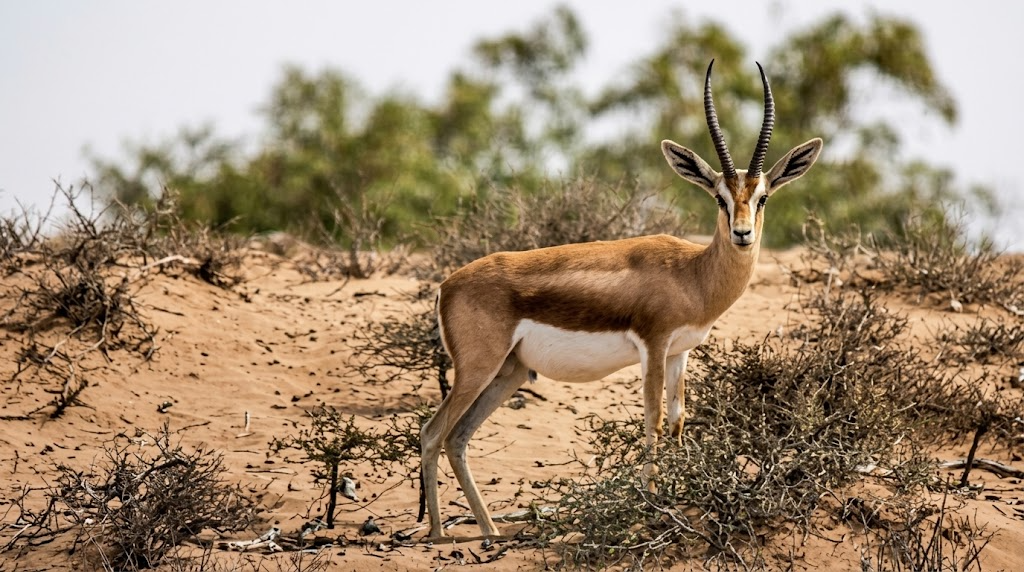
Watch a Dorcas Gazelle for more than a few seconds and it becomes obvious why the species has survived in some of the harshest terrain on earth. Every movement is economical, every pause is alert, and the moment it senses something wrong, it is already gone, a pale streak vanishing across open ground faster than almost anything else on four legs.
The Dorcas Gazelle is one of the smallest and most widespread gazelle species in North Africa, and Morocco holds some of the most important, and most fragile, populations left anywhere in its range.
What is the Dorcas Gazelle?
The Dorcas Gazelle (Gazella dorcas) is a small, slender antelope built for life in arid and semi-arid terrain, standing around 55 to 65 centimeters at the shoulder and weighing between 15 and 20 kilograms. Its coat is a pale sandy fawn above and white below, an easy match for the dry, open ground it lives on, and both males and females carry lyre-shaped, ridged horns, though the female’s are usually thinner and shorter. It is one of the most widely distributed gazelle species historically, once ranging across North Africa and parts of the Middle East, though its populations today are far more fragmented and reduced than that wide range suggests.
What do Dorcas Gazelles eat in the wild?
Dorcas Gazelles are selective grazers and browsers, and their diet shifts with the seasons depending on what the landscape provides. Field studies of Moroccan populations found that in spring they feed heavily on grasses such as Stipa and barley grass along with certain leafy forbs, while in autumn their diet shifts toward different low-growing plants including storksbill and sow thistle. This seasonal flexibility, combined with an ability to browse on shrubs and acacia leaves when grasses are scarce, lets them survive in terrain that offers very little green vegetation for most of the year.
How fast can a Dorcas Gazelle run?
A Dorcas Gazelle can reach roughly 80 kilometers per hour in short bursts, a speed built entirely around escaping predators rather than sustained travel. Rather than outrunning a threat over distance, it relies on a burst of acceleration combined with sharp, unpredictable turns, and its light frame and long legs are shaped for exactly that kind of explosive, short range sprint across open, firm ground.
How do Dorcas Gazelles survive in the desert?
Few large mammals handle extreme heat and water scarcity as efficiently as the Dorcas Gazelle. It can go for extended periods without drinking at all, pulling most of the moisture it needs directly from the plants it eats, and its kidneys are highly efficient at concentrating urine to conserve water. Its pale coat reflects heat rather than absorbing it, and the gazelle shifts its activity toward the cooler hours of early morning, evening, and even night during the hottest months, resting in whatever shade it can find through the middle of the day. It can also tolerate a wider swing in body temperature than most mammals, allowing it to run hotter during the day without needing to sweat away scarce water to cool down.
Dorcas Gazelle status in Morocco
Morocco holds two very different stories under one species name. The distinct Moroccan subspecies, Gazella dorcas massaesyla, has collapsed to a single remnant population confined to the M’Sabih Talaa reserve in west-central Morocco, isolated for roughly 60 years and estimated at fewer than 100 individuals in recent surveys, a decline of nearly 50 percent in nine years, driven largely by poaching and predation from feral dogs. Genuinely wild Dorcas Gazelles disappeared from the Souss Valley, the region around Souss Massa National Park, with the last confirmed record dating back to 1987. The population now found inside Souss Massa National Park’s protected reserves is part of an active breeding and reintroduction program, alongside Scimitar Oryx and Addax, working to reestablish the species across its former Moroccan range rather than a surviving remnant of the original wild population.
Predators of the Dorcas Gazelle
Fawns face the highest risk, taken opportunistically by golden jackals, caracals, foxes, and large birds of prey during their first weeks of life, when they rely on staying hidden and motionless rather than on speed. Adult Dorcas Gazelles are fast and alert enough to outrun most remaining predators across their current Moroccan range, though historically, before their decline, they would also have faced pressure from wolves and cheetahs across parts of their wider North African range, both now absent from most of the region.
Are Dorcas Gazelles dangerous to humans?
No. The Dorcas Gazelle is a small, entirely herbivorous, and naturally skittish animal that avoids human contact whenever possible, fleeing at the first sign of a threat rather than standing its ground. The only real risk it poses is to itself, since its instinct to bolt at speed across unfamiliar terrain can occasionally lead to injury, which is part of why undisturbed, well managed reserve space matters so much for the species’ recovery.
Where to see them for yourself
Inside Souss Massa National Park, Dorcas Gazelles can be observed within the park’s protected steppe reserves, part of the same reintroduction effort supporting Scimitar Oryx, Addax, and the North African Ostrich. Early morning and late afternoon tend to bring the most visible activity, when the gazelles feed in the cooler hours before the midday heat sets in.
If you are planning a trip from Agadir, this guided national park tour covers the steppe reserve where the gazelles roam, along with the park’s other reintroduced species, in a single half day or full day excursion with a local guide.