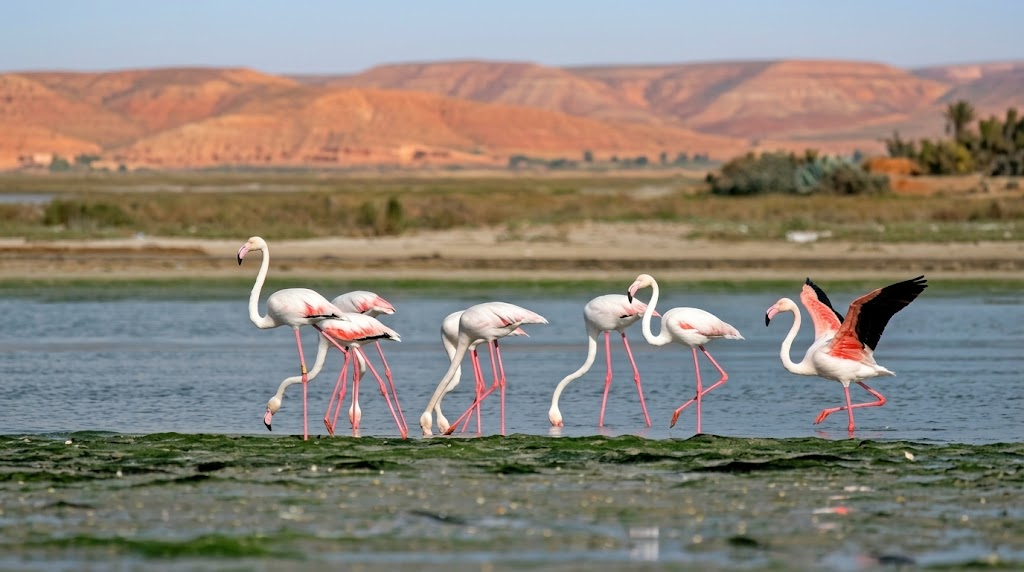
From a distance, a flock of flamingos wading through a Moroccan lagoon looks almost unreal, hundreds of pale pink bodies bent double against the water, all facing the same direction, all feeding on something invisible below the surface. Up close, the bird behind that scene turns out to be even stranger than it looks from a distance.
The Greater Flamingo is the largest and most widespread flamingo species on earth, and Morocco’s Atlantic coast is one of the best places anywhere to see it in real numbers.
What is the Greater Flamingo?
The Greater Flamingo (Phoenicopterus roseus) is the largest living species of flamingo, standing up to 1.5 meters tall on long, thin, pink legs, with a wingspan that can reach 1.5 meters across. Its plumage runs from very pale pink to almost white, with brighter pink patches on the wings that only become visible in flight, and its distinctive downward-curving bill is pale pink with a sharp black tip. That bill shape is not decorative, it is a highly specialized filter-feeding tool, held upside down in the water while the bird sweeps its head side to side, straining small crustaceans, algae, and insect larvae out of the shallows.
Greater Flamingos are highly social birds that almost never appear alone, gathering in colonies that can number in the thousands, and their famous pink color comes entirely from their diet, specifically the carotenoid pigments in the brine shrimp and blue-green algae they filter from shallow, salty water.
Do Greater Flamingos live in North Africa?
Yes, and Morocco in particular holds some of the most important flamingo sites on the entire North African coast. The species is a common passage migrant and winter visitor across the region, with an average of around 5,000 individuals recorded wintering across more than 40 Moroccan wetlands each year, according to BirdLife International’s species data. After more than half a century without a confirmed breeding record in the country, Greater Flamingos began nesting again in Morocco in the 2020s, with active breeding programs now underway at Khnifiss Lagoon and the Marchica lagoon near Nador, and a further nesting site planned at the mouth of the Massa river inside Souss Massa National Park itself.
What is the difference between Greater and Lesser Flamingos?
The two species are often confused, but they are easy to separate once you know what to check.
- Size: the Greater Flamingo is noticeably larger, standing up to 1.5 meters tall, while the Lesser Flamingo rarely exceeds 1 meter
- Color: the Greater Flamingo is pale pink to nearly white with a pink and black bill, while the Lesser Flamingo is a much deeper pink to red, with an almost entirely dark red bill
- Bill shape: the Lesser Flamingo has a smaller, more deeply curved bill adapted for filtering the tiny blue-green algae that make up most of its diet, while the Greater Flamingo’s bill is built for a broader diet including brine shrimp and small invertebrates
- Range: the Greater Flamingo has by far the wider range, found across Africa, southern Europe, and parts of Asia, while the Lesser Flamingo is concentrated mainly around the Rift Valley lakes of East Africa, with only occasional and much rarer breeding records turning up further north
In Morocco specifically, almost every flamingo you see in a coastal lagoon will be a Greater Flamingo. Lesser Flamingo sightings in North Africa remain rare enough to make regional news when they occur.
Are Greater Flamingos endangered in Africa?
Globally, the Greater Flamingo is listed as Least Concern, and the west Mediterranean metapopulation has actually grown substantially in recent decades, rising from around 165,000 individuals in 2004 to somewhere between 340,000 and 370,000 by the late 2010s. That said, “not endangered” does not mean “not vulnerable.” Regional breeding colonies remain highly sensitive to disturbance, water level changes, and habitat loss, and a single poor breeding season at a major colony can wipe out an entire year’s worth of chicks. In Morocco, the return of confirmed breeding after more than 50 years is treated by ornithologists as a genuinely fragile, closely monitored conservation success rather than a settled recovery.
Threats to Greater Flamingo in North Africa
The species faces a mix of pressures across its North African range. Wetland drainage and agricultural water extraction reduce the shallow, salty lagoons the birds depend on for feeding and nesting. Human disturbance near breeding colonies, from tourism, fishing, or development, can cause adults to abandon nests entirely, since flamingos are notably sensitive to interference during the breeding season. Climate-driven changes to rainfall and drought cycles also affect water levels at key sites like Khnifiss Lagoon and Merja Zerga, which can make or break a breeding attempt in any given year. Conservation groups working across Morocco have responded by building artificial nesting platforms at several key lagoons, a technique credited with encouraging the species back to breeding activity after decades of absence.
Best places to see flamingos in Morocco
A handful of coastal wetlands account for most of Morocco’s flamingo sightings:
- Merja Zerga, near Moulay Bousselham, a Ramsar-listed lagoon where more than 1,000 Greater Flamingos can gather in winter alongside tens of thousands of other waterbirds
- Khnifiss Lagoon, one of the largest coastal wetlands in Morocco and a key site in the country’s renewed flamingo breeding program
- Oualidia lagoon, a smaller but reliable wintering site on the central Atlantic coast
- Souss Massa National Park, where flamingos feed regularly around the Oued Massa estuary and are included in the future breeding program planned for the river mouth
Greater Flamingo habitat in Morocco’s wetlands
Greater Flamingos need shallow, still, and typically brackish or saline water, the kind found in coastal lagoons, tidal estuaries, and salt pans rather than fast-moving rivers or deep lakes. Inside Souss Massa National Park, the Oued Massa estuary provides exactly this kind of habitat where the river meets the Atlantic, creating shallow tidal flats rich in the small invertebrates flamingos filter from the water. This is the same estuary that hosts the park’s Northern Bald Ibis colony, making the river mouth one of the single richest birdwatching stretches on Morocco’s entire coast.
Where to see them for yourself
The Oued Massa estuary inside Souss Massa National Park is one of the most reliable places on Morocco’s Atlantic coast to see Greater Flamingos feeding in the wild, often alongside osprey, spoonbill, and the park’s famous Northern Bald Ibis colony. Early morning tends to bring the highest numbers, before the estuary gets busy and before the heat sets in.
If you are planning a trip from Agadir, this guided national park tour covers the estuary and its flamingo feeding grounds as part of a single half day or full day excursion with a local birding guide.