Most people picture an ostrich as a farmyard bird, something raised for feathers or leather on a ranch somewhere. Almost nobody pictures it as one of the rarest large animals left in the Sahara, a bird so reduced in number that biologists spent fifty years unsure whether it still nested in the wild at all.
The North African Ostrich is that bird. And in 2024, on the dry steppe of Souss Massa National Park, it finally proved everyone wrong.
What is the North African Ostrich?
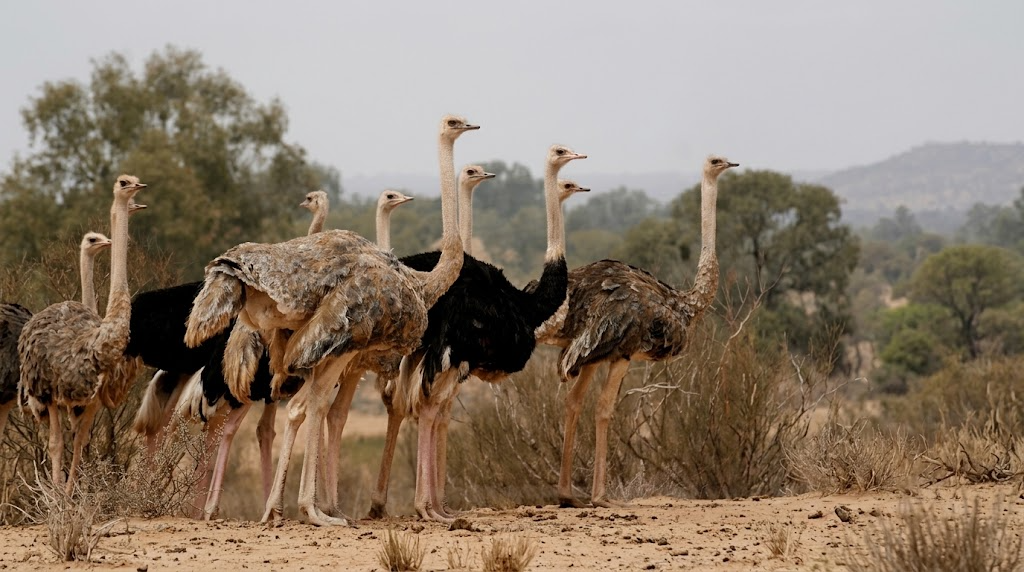
The North African Ostrich (Struthio camelus camelus), also called the red-necked ostrich or Barbary ostrich, is the nominate subspecies of the common ostrich and the largest living bird on the planet. Adults reach up to 2.74 meters tall and 154 kilograms, with a pink to red neck, black and white plumage on males, and gray plumage on females. It once ranged across nearly the entire width of Africa, from Senegal and Mauritania in the west, through the Sahel, all the way to Egypt, Sudan, and southern Morocco in the east.
That range has collapsed almost completely. The subspecies has disappeared from most of North Africa and now survives in small, fragmented pockets, mainly in Chad, Cameroon, the Central African Republic, and parts of Senegal, along with a small but growing reintroduced population in Morocco.
How many North African Ostriches are left in the wild?
Nobody has an exact wild count, and that uncertainty is itself part of the problem. The subspecies is listed under CITES Appendix I, and some conservation bodies treat it as Critically Endangered, since it now occupies roughly 0.2 percent of its original range. Truly wild, self-sustaining populations are believed to survive only in isolated pockets of Chad and neighboring countries, with numbers likely in the low thousands at most, though reliable surveys across such a vast and remote range are extremely difficult to carry out.
Morocco’s story is a rare bright spot. In 1996, around 30 ostriches were transferred from Chad to Souss Massa National Park to found a protected breeding population. By the late 2000s, that group had grown to roughly 150 adults, the largest semi-captive population anywhere in the Sahelo-Saharan region. Today more than 300 individuals live across several protected sites in Morocco, and in 2024 the species did something it had not done in the wild in Morocco for half a century, it built a nest and hatched chicks entirely on its own inside Souss Massa National Park.
Are North African Ostriches dangerous to humans?
They can be, though serious incidents are rare and almost always provoked. An adult male can stand close to 2.7 meters tall and deliver a powerful forward kick strong enough to injure a predator or a person, and males become territorial and defensive during the breeding season, particularly around nests. In a protected reserve setting like Souss Massa, ostriches generally keep their distance from visitors on guided routes, and the real risk applies mainly to anyone who approaches on foot uninvited or gets between a male and his nest. As with most large wild animals, the sensible rule is simple: observe from a distance and never approach a nesting bird.
North African Ostrich habitat in the Sahara Desert
Historically, the North African Ostrich favored open, arid terrain, semi-desert steppe, sparse grassland, and the transition zones between true desert and the Sahel, rather than deep sand dunes. It needs wide sightlines to spot predators from a distance and firm, open ground to reach its running speed of up to 70 kilometers per hour when threatened. In Morocco, the reintroduced population occupies exactly this kind of terrain, the dry steppe and semi-arid flats inside Souss Massa National Park, alongside reintroduced Dorcas gazelle and Scimitar Oryx that share the same open habitat.
North African Ostrich vs Common Ostrich comparison
This comparison trips a lot of people up, because the North African Ostrich is not a separate species from the common ostrich, it is one of several subspecies within it. The common ostrich, Struthio camelus, is the species-level name, and it splits into a handful of regional subspecies, including the North African Ostrich (S. c. camelus), the South African Ostrich (S. c. australis), and the Masai Ostrich (S. c. massaicus) of East Africa. So asking “North African Ostrich vs common ostrich” is really asking how one subspecies compares to its closest relatives within the same species, and the North African form stands out as the largest of them all, with a distinctly pinkish-red neck and legs rather than the gray or blue-gray tones seen in other subspecies.
Difference between North and South African Ostrich
The South African Ostrich (Struthio camelus australis) is the subspecies most people have actually encountered, since it is the one most commonly farmed worldwide for meat, leather, and feathers. The two are easy to separate once you know the differences:
- Neck and leg color: the North African Ostrich has a pink to red neck and legs, while the South African Ostrich has gray to blue-gray neck and legs
- Size: the North African Ostrich is the larger of the two subspecies, and the largest of all living ostriches
- Range: the North African Ostrich historically spanned West and North Africa and the Sahel, while the South African Ostrich is native to Southern Africa and is now the dominant subspecies in commercial ostrich farming worldwide
- Conservation status: the North African Ostrich is Critically Endangered in the wild across most of its range, while the South African Ostrich remains common, largely due to its extensive use in farming
Can you see North African Ostriches in the wild?
Yes, though it takes going to the right place. Truly wild sightings across the Sahara are exceptionally rare, reserved mostly for researchers working in remote parts of Chad. For nearly everyone else, Morocco offers the most reliable and accessible way to see the subspecies, since the reintroduced population inside Souss Massa National Park now roams freely across a large protected reserve, and as of 2024, breeds there entirely on its own. Early morning and late afternoon, when the birds are most active and the light is best, tend to be the most reliable times to spot them foraging across the open steppe.
Where to see them for yourself
The North African Ostrich’s return to Souss Massa National Park is one of the most significant conservation comebacks on this stretch of Morocco’s coast, sitting alongside the park’s Northern Bald Ibis colony and reintroduced Scimitar Oryx and Dorcas Gazelle populations. A visit to the park’s steppe reserve is currently one of the only realistic ways in the world to see this subspecies moving, foraging, and nesting in something close to its natural range.
If you are planning a trip from Agadir, this guided national park tour covers the steppe reserve where the ostriches roam, along with the park’s other reintroduced species, in a single half day or full day excursion with a local guide.