
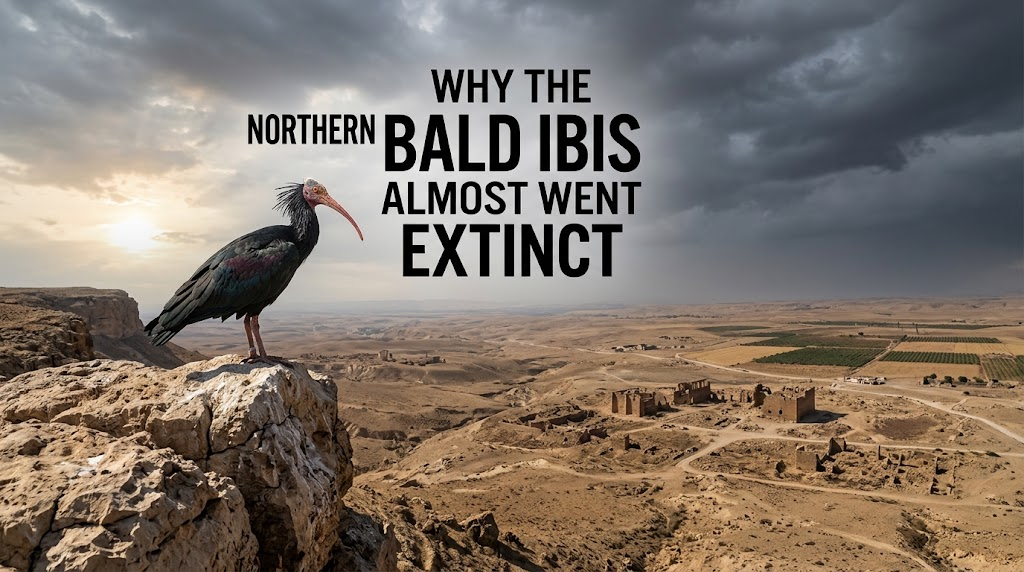
Three separate continents. Three separate collapses. By the time anyone treated the Northern Bald Ibis as an emergency rather than a curiosity, the species had already been quietly erased from Europe, was actively disappearing from the Middle East, and existed almost nowhere in the wild except one remote stretch of Morocco’s Atlantic coast. This is the story of how that happened, and why Morocco ended up being the one place where it did not.
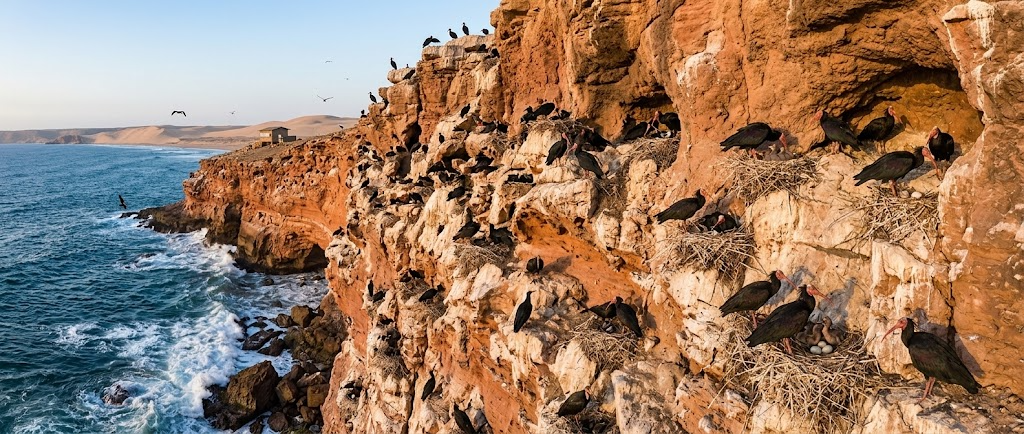
A bird that once nested across three continents
It is easy to forget, looking at how rare the Northern Bald Ibis is today, that this was once a genuinely widespread species. Fossil and historical records place breeding colonies across central Europe, North Africa, and the Middle East, spanning a range that touched the Alps, the Atlas Mountains, and the deserts bordering the Red Sea. It appears in Ancient Egyptian art, in medieval European bestiaries, and in early natural history texts across three continents, evidence of a bird that was, for most of recorded history, simply part of the landscape rather than a conservation emergency.
The first collapse: hunted out of Europe by the 1600s
Europe’s ibis colonies disappeared first, and disappeared fast. The species bred on accessible cliff ledges in dense colonies, and its fledglings could be taken by hand before they ever learned to fly, an easy, reliable source of food for anyone willing to climb. Colonies across the Alps and central Europe were hunted out systematically, and by the early 1600s the species was gone from the continent entirely. There was no gradual decline to notice and respond to, by the time European naturalists began seriously documenting wildlife populations, the Northern Bald Ibis was already a historical footnote on that continent, not a living bird anyone expected to see.
The Middle East: a sacred bird undone by pesticides
The Middle Eastern population told a different, slower kind of tragedy. In Birecik, Turkey, the local colony held genuine religious and cultural significance, tied to local Islamic tradition and actively protected by the community for generations, a rare case of a wild bird colony surviving specifically because people valued it rather than hunted it. That protection could not save it from an entirely different threat. Beginning in the mid twentieth century, agricultural pesticides, used heavily on cotton crops across the region, accumulated in the birds’ food chain and are widely believed to have driven a sharp, sustained decline. By the 1970s, the wild colony had crashed so severely that the remaining birds were taken into captivity entirely, ending true wild breeding in Turkey and leaving only a managed, semi-captive population behind.
War and the collapse of the Syrian colony
For decades afterward, researchers believed the Middle Eastern wild population was entirely gone. Then, in 2002, a small relict colony was rediscovered near Palmyra, Syria, just seven birds, a genuine scientific surprise and a rare second chance for the eastern population. Conservationists fitted the birds with satellite tags, tracking their migration south to wintering grounds in Ethiopia across Saudi Arabia, Jordan, and Sudan, gathering exactly the kind of data that could have informed a real recovery plan. Instead, the Syrian civil war overtook the effort. Conflict made consistent monitoring and protection impossible, and the tiny population was picked apart over the following years by a combination of hunting, disturbance, and the simple chaos of a warzone surrounding its breeding cliffs. According to BirdLife International’s account of the eastern population’s collapse, by the late 2010s the wild eastern population was considered functionally extinct, a second chance that conflict and circumstance ultimately closed.
The deadliest migration route of any ibis
Even setting aside the Syrian war specifically, the eastern population’s migratory lifestyle was itself a major part of the problem. Unlike a sedentary population that stays in one protected area year round, the historical eastern birds undertook one of the longest migratory journeys of any ibis species, crossing Eritrea, Sudan, Saudi Arabia, Jordan, and Yemen twice a year between breeding grounds in Turkey and Syria and wintering grounds in Ethiopia. Every one of those countries represented a fresh set of risks, hunting pressure, power line collisions, and habitat disturbance, that the birds had to survive twice annually just to complete a normal life cycle. A population already reduced to single digits simply could not absorb that level of cumulative risk year after year.
Why Morocco’s population survived when others did not
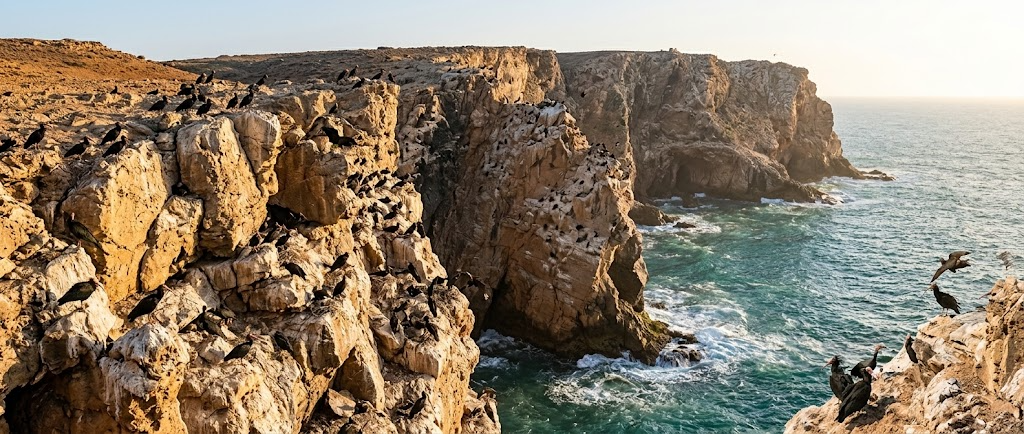
Morocco’s Atlantic coast avoided almost every specific failure point that ended the species elsewhere, and understanding why is the real key to why this particular population became the species’ last true wild stronghold. Critically, the Moroccan colony is non-migratory, remaining year round along the same protected stretch of coastline rather than undertaking a dangerous seasonal journey through half a dozen countries. That single behavioral difference removed the single biggest source of mortality that doomed the eastern population. Morocco also offered relative political stability compared to the conflict that devastated the Syrian colony, allowing consistent, uninterrupted conservation work across decades rather than years of enforced neglect during active war. Finally, the establishment of Souss Massa National Park itself gave the colony a genuinely protected nesting area, insulated from the kind of unregulated hunting and disturbance that wiped out European and early Middle Eastern populations centuries earlier. It was not luck alone, it was the accumulated advantage of staying put, staying protected, and staying out of a warzone.
The species today: recovering, not recovered
The results of that combination are genuinely striking. Morocco’s population has grown from around 200 birds in the 1990s to roughly 600 to 700 today, and in 2018 the species was formally reclassified from Critically Endangered to Endangered on the IUCN Red List, a meaningful step reflecting that sustained growth. It remains, however, a single population concentrated in one region, which is precisely the vulnerability that made the European and Middle Eastern collapses so total in the first place. A single serious disease outbreak, a major disturbance event, or a shift in local protection policy could still threaten the entire wild population at once, which is why conservationists continue to describe the species as recovering rather than safe.
Where to see the survivors
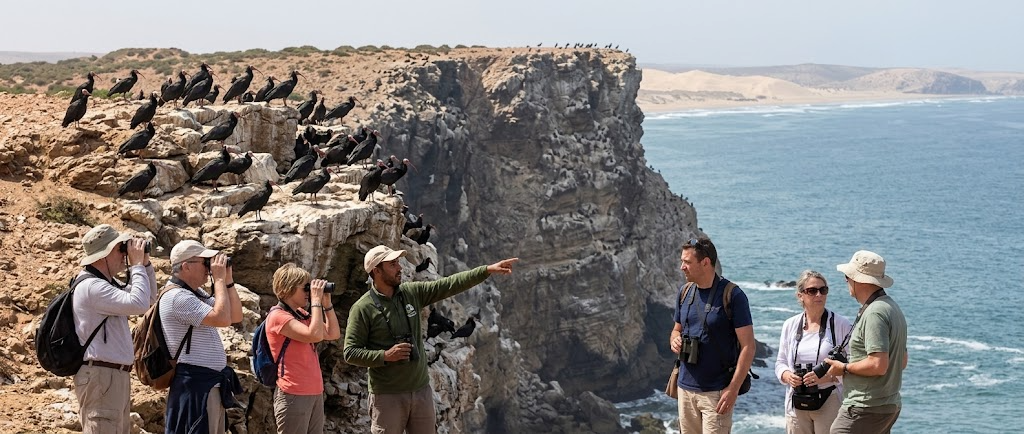
Souss Massa National Park is not simply a good place to see the Northern Bald Ibis, it is essentially the only place left on earth where the species still breeds as a genuinely wild, self-sustaining population, the direct result of the specific conditions explored above. Seeing the colony here means seeing the living outcome of a species that came within a hair’s breadth of disappearing entirely, on three separate continents, for three entirely different reasons.
Plan your visit
Full details on visiting, including hours, entrance information, and how to get here, are available on the park’s visitor information page. For more on the species itself, see our full Northern Bald Ibis species guide.
If you are planning a trip from Agadir, this guided national park tour covers the estuary and coastal cliffs where the colony nests, as part of a single half day or full day excursion with a local guide.