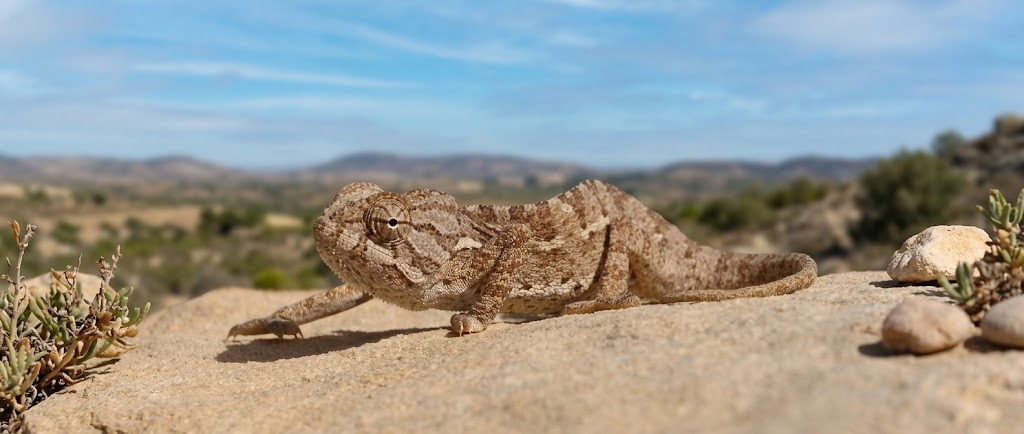
Most lizards move to escape notice. This one has built an entire survival strategy around barely moving at all, rocking gently back and forth like a leaf in the breeze, eyes swiveling independently in two directions at once, waiting for an insect to wander within striking distance of a tongue that can outreach its entire body in a fraction of a second.
The Mediterranean Chameleon is genuinely present across much of Morocco, including the scrubland around Souss Massa National Park, though its slow, camouflaged lifestyle means most visitors walk right past one without ever noticing.
What is the Mediterranean Chameleon?
The Mediterranean Chameleon (Chamaeleo chamaeleon), also called the common chameleon, is the only chameleon species with a range that naturally extends into Europe, found around the Mediterranean Basin, parts of the Middle East, and across North Africa. It has the unmistakable chameleon body plan, a laterally flattened frame, independently swiveling eyes that give it near 360 degree vision, a prehensile tail used like an extra limb for gripping branches, and the ability to shift skin color between shades of green, yellow, brown, and grey depending on temperature, mood, and light rather than purely for camouflage, as is commonly assumed. It is an arboreal, slow-moving, sit-and-wait predator that relies almost entirely on stillness and a lightning-fast, sticky-tipped tongue to catch prey.
Are Mediterranean Chameleons found in Morocco?
Yes, widely so. Morocco holds one of the largest and most continuous ranges for this species anywhere in its distribution, with populations recorded from sea level all the way up to 1,800 meters in the High Atlas mountains. It remains relatively common in certain areas of the country, though populations are declining in places due to habitat degradation, and according to field observations from Moroccan herpetologists, road traffic has become one of the single biggest threats to the species nationally, since chameleons crossing increasingly busy roads are frequently struck by vehicles.
Mediterranean Chameleon size in Morocco
Adults typically measure between 20 and 40 centimeters in total length, including the tail, with females often growing noticeably larger than males, an unusual pattern compared to many reptile species. Coloration is highly variable even within a single population, ranging from bright green to yellowish brown to dark grey, and every individual retains a pair of pale lines running along each side of the body regardless of its current background color.
What do Mediterranean Chameleons eat?
Mediterranean Chameleons are almost entirely insectivorous, feeding on grasshoppers, crickets, flies, beetles, and other invertebrates they spot from a perch and catch with a projectile tongue capable of extending to roughly the length of the chameleon’s own body in a fraction of a second. They hunt by patience rather than pursuit, remaining nearly motionless on a branch for long stretches while scanning independently with each eye, then striking the instant prey comes within range. Larger individuals will occasionally take small lizards as well, though insects make up the overwhelming majority of the diet in the wild.
What is the lifespan of a Mediterranean Chameleon?
Most sources put the average wild lifespan at somewhere between two and five years, with females that survive to adulthood sometimes living slightly longer than males. Precise, well documented longevity studies specific to wild Moroccan populations remain limited, and captive individuals kept in stable, well managed conditions can occasionally live somewhat longer than their wild counterparts, though chameleons in general are not considered a particularly long lived reptile group compared to many lizards and tortoises.
Are Mediterranean Chameleons dangerous?
No. This is a small, entirely harmless insectivore with no venom, no aggressive behavior toward people, and essentially no capacity to harm a human in any meaningful way. Its only real defenses are camouflage, stillness, and a mild hissing or gaping display if directly threatened or picked up, closer to a bluff than any genuine danger. The species poses no risk to visitors observing it from a normal, respectful distance.
Can I buy a Mediterranean Chameleon in Morocco?
You may come across them for sale informally in some markets or tourist areas, but this is worth approaching with real caution. Across much of North Africa, chameleons have long been sold by traditional herbalists for folk medicinal and superstitious purposes rather than as regulated pets, and the species is listed under CITES Appendix II specifically because international trade in wild-caught individuals is a recognized conservation concern. Buying a chameleon from an informal street or market seller in Morocco very likely supports unregulated wild capture rather than any legitimate, permitted breeding operation, and it does the species no favors, given how poorly most chameleons cope with captivity and how quickly wild collection can affect a slow-breeding local population. The most responsible way to enjoy the species is to see one in its natural habitat rather than to buy one at all.
Where to see chameleons in Morocco
Chameleons are easiest to find with a slow, deliberate search rather than a quick walk-through, since their camouflage and stillness make them genuinely difficult to spot by chance. Scrubland, hedgerows, and scattered trees such as carob and mastic across much of coastal and inland Morocco offer good habitat, and Souss Massa National Park’s mix of scrub, dune vegetation, and low woodland provides exactly this kind of terrain. Early morning, when chameleons are often still and warming themselves before the day’s activity picks up, tends to offer the best odds of a sighting, ideally with a guide trained to spot the subtle shape and outline of a motionless chameleon against foliage.
Where to see them for yourself
The scrub and dune vegetation inside Souss Massa National Park offers a genuine chance to spot a Mediterranean Chameleon in the wild, part of the same richly diverse reptile community that includes the park’s Viperine Snake and Aurora Fringe-toed Lizard. Because chameleons rely on stillness and camouflage rather than movement, a slow pace and a sharp eye, ideally guided by someone who knows exactly where to look, make all the difference.
If you are planning a trip from Agadir, this guided national park tour covers the scrub and woodland habitat where chameleons are most often found, as part of a single half day or full day excursion with a local guide.