In 2000, the Scimitar Oryx became one of the only large mammals in modern history to be officially declared extinct in the wild while thousands of individuals still lived on in zoos and private reserves around the world. For nearly two decades, seeing one meant visiting a captive collection, never the open desert. That changed, and Morocco played a genuine role in the comeback.
The Scimitar Oryx is now back in the wild, and Souss Massa National Park has been part of that story since long before most of the world noticed it was happening.
What is the Scimitar Oryx?
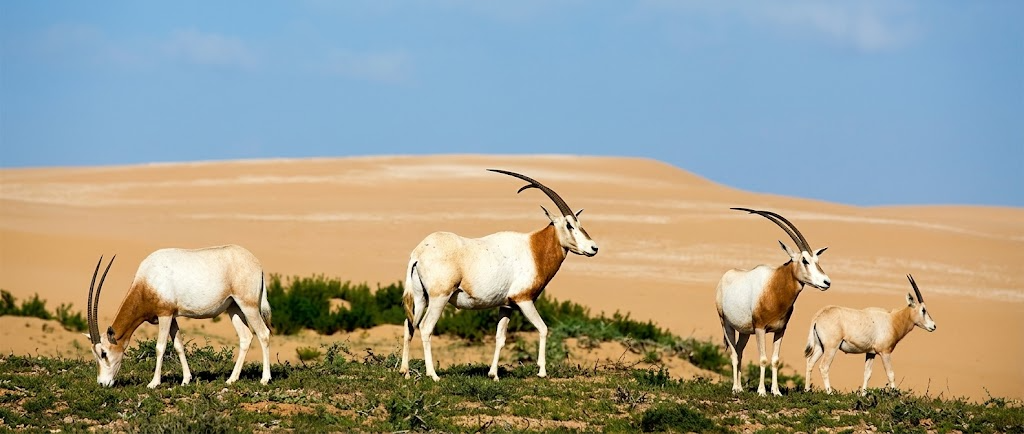
The Scimitar Oryx (Oryx dammah), also called the Scimitar-horned Oryx or Sahara Oryx, is a large desert antelope named for its long, curved horns, which sweep backward in a shape resembling the blade of a scimitar sword and can reach over a meter in length on adult males and females alike. Adults stand around 1.2 meters at the shoulder and weigh up to 210 kilograms, with a mostly white coat, a reddish brown neck and chest, and dark markings on the face. Historically it ranged across the semi-arid grasslands and desert fringes of North Africa, from Morocco and Senegal in the west to Egypt and Sudan in the east, wherever seasonal grazing and shallow groundwater allowed large herds to survive.
Are Scimitar-Horned Oryx extinct in the wild?
No, not anymore, though the answer was yes for nearly two decades. The IUCN declared the species Extinct in the Wild in 2000 after decades of overhunting and habitat loss wiped out every remaining wild population. Starting in 2016, a coalition led by Sahara Conservation and the Environment Agency of Abu Dhabi began releasing captive-bred oryx into Chad’s Ouadi Rimé Ouadi Achim Faunal Reserve, starting with 25 animals flown in from a genetically diverse “World Herd.” The first wild-born calf arrived that same December, and the population has grown steadily ever since. In December 2023, the species was officially reclassified from Extinct in the Wild to Endangered, a genuine world first for a large mammal reintroduction of this scale.
Why are Scimitar-Horned Oryx endangered?
The collapse came fast once modern hunting pressure met a species with almost no natural defenses against it. Motorized hunting parties, often for horns, meat, and hides, swept through the Sahel and Sahara during the 20th century and eliminated herds far faster than the species could recover, since oryx breed slowly and gather in open terrain where they are highly visible. Habitat loss compounded the problem, as expanding livestock grazing and encroaching agriculture pushed into the same semi-arid grasslands the oryx depended on, while prolonged droughts across the Sahel through the 1970s and 1980s further squeezed already declining herds. Ongoing regional instability across parts of its former range remains a real risk to reintroduced populations even today, which is part of why Morocco’s more politically stable reintroduction sites have become so important to the species’ overall recovery.
How many Scimitar Oryx are left in the world?
Counting only genuinely wild, free-ranging animals, more than 600 Scimitar Oryx now live in Chad’s Ouadi Rimé Ouadi Achim reserve, including over 500 wild-born calves since the reintroduction began. Morocco adds a second, separate stronghold, with official estimates putting around 260 individuals across the country’s protected areas and reserves as of 2024, including both captive-managed animals and a smaller group released directly into the wild near Boujdour on the Atlantic Sahara coast in 2019. Beyond these reintroduced and semi-wild populations, several thousand more Scimitar Oryx live in zoos, private ranches, and captive breeding centers worldwide, a captive population that, somewhat unusually for an endangered species, is what made the entire wild reintroduction possible in the first place.
Scimitar-Horned Oryx population in Africa
Africa’s Scimitar Oryx population is currently concentrated in two countries. Chad holds the largest and most genuinely wild population, over 600 animals roaming freely across the Ouadi Rimé Ouadi Achim Faunal Reserve with minimal ongoing management beyond monitoring. Morocco holds the second largest population on the continent, and is considered the species’ strongest stronghold in North Africa specifically, combining protected breeding populations, including a long-running program at Souss Massa National Park, with a smaller free-ranging group established near Boujdour. Small numbers also persist in fenced reserves and breeding programs elsewhere across the species’ historical range, though Chad and Morocco together account for the overwhelming majority of all Scimitar Oryx living outside captivity today.
Are Scimitar Oryx still endangered?
Yes. The 2023 downlisting from Extinct in the Wild to Endangered is a major milestone, not a finish line. The wild and semi-wild populations in Chad and Morocco remain small, geographically concentrated, and dependent on continued monitoring, anti-poaching enforcement, and habitat management to keep growing. A single serious setback, whether disease, drought, or a return of unregulated hunting, could still reverse years of progress, which is why conservation groups describe the species as recovering rather than recovered.
Can you hunt Scimitar-Horned Oryx in Morocco?
No. In Morocco, the Scimitar Oryx is a protected species tied directly to an active national reintroduction and breeding program, and it is not legally hunted in the wild or within the country’s protected reserves. The species is also listed on CITES Appendix I, which restricts international trade in the animal and its parts. It is worth noting that legal trophy hunting of captive-bred Scimitar Oryx does exist elsewhere in the world, mainly on private game ranches in the United States under specific regulatory exemptions, but that framework is entirely separate from Morocco’s conservation-focused reintroduction program and does not apply here.
How to see Scimitar Oryx in Morocco
Souss Massa National Park is one of the most established places in the country to see the species, having served as a captive breeding center for Saharan antelope for years before playing a role in the species’ wider recovery. Oryx here are kept within large, protected steppe enclosures that closely mimic natural habitat, alongside Addax and Dorcas Gazelle from the same reintroduction effort. Early morning and late afternoon tend to be the most active times to see them moving and grazing across the open terrain.
Where to see them for yourself
Inside Souss Massa National Park, the Scimitar Oryx shares its protected reserve with Addax, Dorcas Gazelle, and the North African Ostrich, all part of the same long-running effort to bring back species that had vanished from Morocco’s wild landscape. It remains one of the most reliable places on the continent to see this once extinct-in-the-wild antelope up close.
If you are planning a trip from Agadir, this guided national park tour covers the steppe reserve where the oryx roam, along with the park’s other reintroduced species, in a single half day or full day excursion with a local guide.