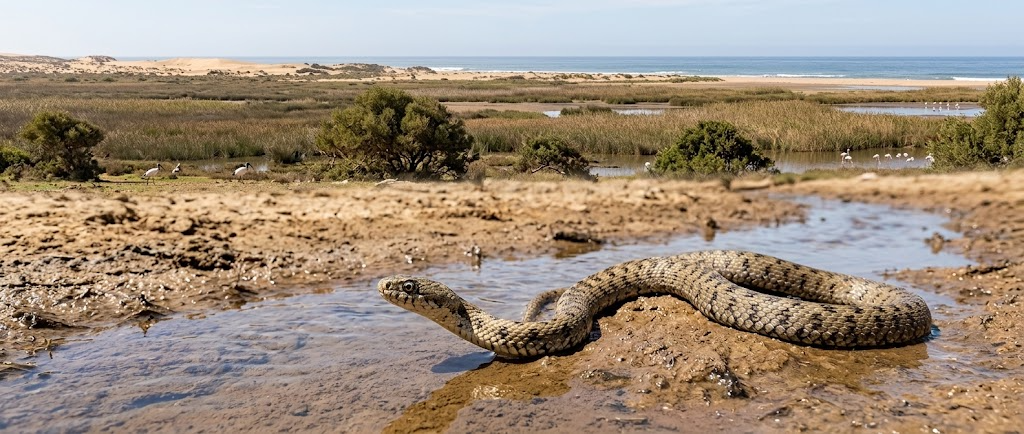
Nearly every summer, somewhere along a river or lagoon in Morocco, someone spots a patterned, zigzag-marked snake gliding through shallow water and reacts the exact same way, with a jolt of alarm at what looks unmistakably like a viper. The reaction is understandable. It is also almost always wrong.
The Viperine Snake is one of the most widespread reptiles at Souss Massa National Park’s wetlands, and despite its name and its convincing impression of a dangerous snake, it is completely harmless.
What is the Viperine Snake?
The Viperine Snake (Natrix maura), also called the viperine water snake, is a semiaquatic, fish-eating snake found across southwestern Europe and northwestern Africa, including throughout most of Morocco. It gets its common name purely from appearance and behavior, not biology. Its zigzag dorsal pattern, dark oval blotches, and defensive posture closely mimic those of true vipers, an adaptation that helps scare off predators, but the resemblance is entirely superficial. It belongs to the Natricinae, a subfamily of harmless water snakes, and is not related to the venomous viper family at all. Adults typically reach 60 to 100 centimeters, with a wide, flattened head, upward-angled nostrils and eyes suited to life at the water’s surface, and a slender, olive-brown to grey body marked with a dark zigzag stripe and rows of black spots.
Is the Viperine Snake in Morocco poisonous?
No, not in any way that matters to a person. Like other members of the Natricinae, the Viperine Snake does have a small venom-producing gland, called the Duvernoy’s gland, but it has no fangs to deliver that venom effectively, the gland simply drains near the rear teeth and appears to assist with subduing small prey during swallowing rather than functioning as a real weapon. The species rarely bites at all, even when picked up or seriously stressed, and any bite that does happen would be no more significant than a scratch. Its actual defense strategy has nothing to do with biting, it relies entirely on looking dangerous rather than being dangerous.
Are there poisonous snakes in Morocco?
Yes, though they are a different group entirely from the harmless, water-loving Viperine Snake. Morocco is home to roughly eight venomous snake species, the large majority of them true vipers, including the horned viper (Cerastes cerastes), the Moroccan viper (Daboia mauritanica), and the puff adder (Bitis arietans), according to toxicological research into Moroccan viper venom, which found these three species responsible for the large majority of serious snakebite cases in the country. These species generally favor dry, rocky, or sandy terrain rather than the rivers, lagoons, and wetland margins where the Viperine Snake lives, which is one practical reason the two groups are rarely confused by anyone who checks the habitat as well as the pattern.
Viperine Snake vs viper identification guide
A few reliable features separate the harmless Viperine Snake from an actual viper, even at a distance:
- Pupil shape: the Viperine Snake has round pupils, while true vipers have vertical, slit-shaped pupils, similar to a cat’s
- Body build: the Viperine Snake has a slender, streamlined body suited to swimming, while vipers typically have a much stockier, heavier build
- Habitat: the Viperine Snake is almost always found in or very close to water, rivers, lagoons, marshes, and estuaries, while Morocco’s venomous vipers favor dry, rocky, or sandy desert and semi-desert terrain
- Behavior: the Viperine Snake flees quickly when it can, and only bluffs with a viper-like strike and hiss display as a last resort, while true vipers tend to rely on camouflage and a genuine, fast strike as their primary defense
- Head shape: vipers typically have a distinctly triangular head that is much wider than the neck, while the Viperine Snake’s head, though flattened, is less dramatically distinct from its neck
How to identify snakes in Morocco
A cautious, methodical approach works far better than trying to memorize every species. Start with habitat, since Morocco’s water-associated snakes, like the Viperine Snake and the Grass Snake, occupy a very different niche than its desert vipers and dry-country colubrids like the Montpellier Snake. Next, check the pupil shape and head profile from a safe distance if the snake is still, round pupils and a less exaggerated triangular head generally indicate a harmless colubrid or natricine species, while vertical pupils and a broad, wedge-shaped head are a signal to keep well back. Movement and behavior matter too, most non-venomous Moroccan snakes will attempt to flee rather than stand their ground. Whatever the species, the safest identification method is always distance and a photograph rather than a closer look.
Common snakes found in Morocco
Morocco’s snake fauna is genuinely diverse for a country of its size, spanning wetlands, forest, steppe, and true desert. Commonly encountered species include the Viperine Snake in and around water, the Montpellier Snake across dry steppe and scrubland, and several viper species restricted mainly to arid and desert terrain, including the horned viper and the Moroccan viper. Souss Massa National Park itself sits within an internationally recognized reptile biodiversity hotspot, part of a documented community of at least 23 reptile species recorded within the park’s boundaries, according to a peer-reviewed study of the park’s reptile biodiversity, making it one of the richest single sites for reptile diversity anywhere in the Mediterranean region.
What should I do if bitten by a snake in Morocco?
Treat any snakebite in Morocco as a medical emergency until proven otherwise, since telling a harmless species from a dangerous one in the moment is not always reliable. If you or someone with you is bitten:
- Move away from the snake calmly, without attempting to catch, kill, or closely examine it
- Keep the person still and calm, since a raised heart rate can speed the spread of venom if the snake was venomous
- Immobilize the bitten limb, keeping it at or slightly below heart level, and remove any rings, watches, or tight clothing near the bite before swelling begins
- Seek emergency medical care immediately, calling local emergency services or heading directly to the nearest hospital or clinic
- Do not apply a tourniquet, cut the wound, attempt to suck out venom, or apply ice, all of which are outdated methods that can make an envenomation significantly worse
- If it is safe to do so, take a photo of the snake from a distance to help medical staff identify the species and select the right antivenom
This is general safety information rather than medical advice, and it applies to any snakebite anywhere, not only in Morocco. Anyone specifically concerned about a real bite should contact local emergency services or a medical professional right away rather than relying on guidance found online.
Where to see them for yourself
The wetlands and estuary margins inside Souss Massa National Park are one of the more reliable places on Morocco’s Atlantic coast to spot a Viperine Snake hunting or basking near the water, part of the same richly documented reptile community that includes the Montpellier Snake and Aurora Fringe-toed Lizard. As with any wild snake, admiring one from a respectful distance is the right approach, both for your safety and the animal’s.
If you are planning a trip from Agadir, this guided national park tour covers the estuary and wetland habitat where the Viperine Snake is most often seen, as part of a single half day or full day excursion with a local guide.